
This Week:
-
BUGATTI Automobiles S.A.S.
established
. -
Toyota to Introduce New Fuel
Cell Hybrid Vehicle at International Symposium
. -
Ford Names Codina to Key
Marketing Position
. -
Audi A4 in Euro NCAP crash
test
. -
BMW presents current
Telematic projects at CeBIT
. -
Telefónica MoviStar And Repsol YPF: The two official SEAT Sport teams for 2001
. -
Volvo Advances Car Safety With National Instruments Software; Engineers at State-of-the-Art
. -
AutoWeek Award for Opel
Astra Coupé OPC X-TREME
.
© 1998
- 2001 Copyright &
Disclaimer
Automotive Intelligence,
www.autointell.com
All Rights Reserved .
For questions please contact
editor@autointell.com

News of March 07, 2001
Toyota to Introduce New Fuel Cell Hybrid Vehicle at International Symposium
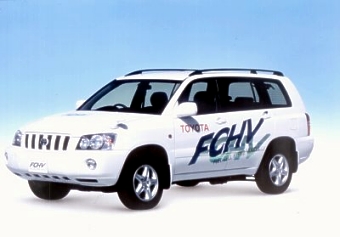
Fuel Cell Hybrid Vehicle
Photo: TMC
Tokyo, JAPAN - TOYOTA MOTOR CORPORATION (TMC) announced -that it will introduce the FCHV-3, its latest fuel cell hybrid vehicle (FCHV), at the International Symposium on Fuel Cell Vehicles to be held on March 1 and 2 in Tokyo under the sponsorship of the Ministry of Land, Infrastructure and Transport.
Ever since it began full-fledged development in 1992, TMC has been actively promoting fuel-cell-powered vehicles. At EVS-13* in 1996, TMC demonstrated a FCHV that stores hydrogen in an hydrogen-absorbing alloy tank, and, in 1997, it unveiled the world’s first FCHV featuring a methanol reformer for the on-board creation of hydrogen.(* 13th International Electric Vehicle Symposium).
In parallel with these efforts, TMC has initiated research on a wide range of fuel sources such as gasoline, natural gas and liquid hydrogen, as well as development of components for use with such types of fuel. In January this year, TMC announced a plan for the development of clean hydrocarbon fuel (CHF), an evolved form of gasoline.
Although these varied approaches open up several possibilities for fuel selection, TMC believes that, in terms of cleanliness and efficiency, fuel-cell vehicles that directly employ pure hydrogen will become mainstay in the future. With the aim of bringing just such vehicles one step closer to reality, TMC has developed the FCHV-3 to be introduced at the symposium as a new type of FCHV.
The FCHV-3 features a hydrogen-absorbing alloy tank and in acknowledging recent calls for cuts in CO2 emissions among SUVs a body based on the Kluger V sports utility vehicle, as well as a highly efficient 90 kW fuel cell stack and other unique FCHV systems developed by TMC.
Furthermore, the FCHV-3 has a secondary battery for storing energy created during braking and other features that ensure high-efficiency driving, such as precise control of the charge and discharge of the secondary battery and of supplementary power supply from that battery to the motor.
TMC is committed to continuing development of FCHVs and intends to begin road tests this summer.
Specifications of FCHV-3:
|
Vehicle base platform |
Kluger V |
|
Dimensions |
4,685 x 1,825 x 1,720 mm |
|
Maximum speed |
Higher than 150 km/h |
|
Cruising distance |
More than 300 km |
|
Seating capacity |
5 persons |
|
Fuel cell stack type |
Polymer electrolyte fuel cell |
|
Output |
90 kW |
|
Motor type |
Synchronized permanent magnet |
|
Maximum output |
80 kW |
|
Maximum torque |
260 Nm |
|
Fuel type |
Pure hydrogen |
|
Storing method |
Hydrogen-absorbing alloy tank |
|
Secondary battery type |
Nickel-metal hydride battery |
(Feb. 28, 2001)
[Homepage] [
News] [ Companies] [
Management] [ Publications]
[ Events] [ Careers]
[Services] [Discussion] [
Guestbook]
[ Search]