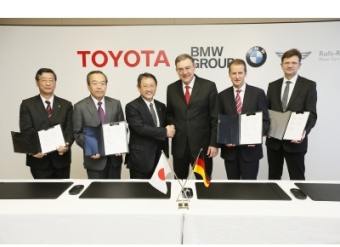
BMW Group and Toyota
Motor Corporation Deepen Collaboration by Signing Binding Agreements
Munich - BMW
Group and Toyota Motor Corporation (TMC) are pursuing their successful
strategic long-term cooperation in the field of sustainable mobility
today by signing binding agreements aimed at long-term collaboration
between the two companies for the joint development of a fuel cell
system, joint development of architecture and components for a sports
vehicle, and joint research and development of lightweight technologies.
These agreements follow a memorandum of understanding signed in June
2012.
Furthermore, BMW Group and TMC also today signed a binding agreement to
commence collaborative research on lithium-air batteries, a
post-lithium-battery solution. This agreement marks the second phase of
collaborative research into next-generation lithium-ion battery cells
that commenced in March 2012.
The main points of the agreements are:
1. Fuel cell system
- The companies are convinced that fuel
cell technology is one of the solutions necessary to achieve zero
emissions. BMW Group and TMC are to share their technologies and to
jointly develop a fundamental fuel-cell vehicle system, including not
only a fuel cell stack and system, but also a hydrogen tank, motor and
battery, aiming for completion in 2020.
- The companies are to collaborate in
jointly developing codes and standards for the hydrogen infrastructure
which are necessary for the popularization of fuel cell vehicles.
2. Sports vehicle
- The companies agreed to set-up a
feasibility study to define a joint platform concept for a mid-size
sports vehicle that is to be completed by the end of 2013. The two
companies aim to combine each other’s technology and knowledge at a high
level to maximise customer satisfaction. Both companies are to share the
vision to further collaborate in the field of sports vehicle
development.
3. Lightweight technology
The companies are to jointly develop
lightweight technologies for vehicle bodies using cutting-edge materials
such as reinforced composites, with an eye to utilize these technologies
in cooperation on the joint development of a sports-vehicle platform as
well as other BMW and TMC vehicles.
4. Post-lithium-battery technology
The companies are to begin joint research
with a goal to develop a lithium-air battery with energy density greatly
exceeding that of current lithium-ion batteries.
Norbert Reithofer, Chairman of the Board
of Management of BMW AG said: “TMC and the BMW Group share the same
strategic vision of future sustainable mobility. In light of the
technological changes ahead, the entire automotive industry faces
tremendous challenges, which we also regard as an opportunity. This
collaboration is an important building block in keeping both companies
on a successful course in the future.”
Akio Toyoda, President of TMC said: “It is
just over a year since we signed our collaborative MoU, and with each
day as our relationship strengthens, we feel acutely that we are making
steadfast progress. Now, we are entering the phase that promises the
fruit. While placing importance on what we learn from the joint
development, we will work hard together in reaching our common goal of
making ever-better cars.”
BMW Group and TMC first agreed to form a
medium-to-long-term collaborative relationship for developing
next-generation environment-friendly vehicles and technologies in
December 2011, at which time the two companies also signed a contract
under which BMW Group is to supply highly efficient diesel engines to
Toyota Motor Europe. BMW Group and TMC ― as long-term strategic partners
― have since continued their joint efforts to realize sustainable
mobility for the future.