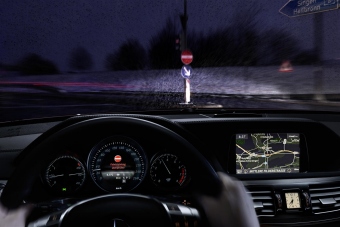
Mercedes-Benz: Real
Life Safety - First assistance system in the fight against vehicles
driving on the wrong side of the road
Stuttgart - In recent
months there have been a shocking number of fatal accidents caused by
so-called wrong-way drivers. Mercedes‑Benz has now developed an
assistance system which aims to eliminate this threat and can even
prevent drivers from driving unintentionally in the opposite direction
to the flow of traffic.
The new traffic sign
assistance system designed by the Stuttgart-based premium manufacturer
is able to recognise no-entry signs and issues an acoustic and visual
warning to the driver if he or she should stray on to the incorrect
carriageway and become a dangerous wrong-way driver. The new system will
be available for the new Mercedes‑Benz S‑Class, due to be launched this
year and the facelifted E‑Class.
"There's a vehicle driving the wrong way
on the A1, the A2, the A5, the A46…" – over the last three months, this
type of report has been worrying Germany almost weekly. During this
short period, more than 25 people died through no fault of their own
because they collided with a vehicle travelling the wrong way on
motorways or dual carriageways.
However the reality is still more
shocking. As a rule wrong-way drivers are only mentioned by the media
when their actions end with victims who are either badly or fatally
injured. The number of wrong-way drivers, known in German as "phantom
drivers" (Geisterfahrer), is actually much higher. The German Federal
Department of Transport estimates that about 1700 radio warnings about
phantom vehicles on German roads are issued annually. The ADAC speaks of
up to 2800 wrong-way drivers annually – that is more than seven a day.
In most cases wrong-way driving ends without tragedy, but the threat of
wrong-way drivers still accompanies drivers every day.
In order to prevent anyone becoming a
wrong-way driver – whether by mistake, due to inattentiveness, stress
resulting from heavy traffic or complicated road designs – Mercedes‑Benz
has developed a new traffic sign assistance system which, amongst other
things, can warn drivers should they violate traffic regulations and
ignore no-entry signs. This makes the system a useful instrument which,
above all, can prevent drivers from entering the motorway via the wrong
slip road.
Professor Thomas Weber, Member of the
Board of Management of Daimler AG, responsible for Group Research and
Mercedes-Benz Cars Development: "On our journey towards the vision of
accident-free driving, Mercedes-Benz orientates itself on real-life
accident situations in order to provide the best possible protection to
all road users. The very idea that we will be using the Mercedes‑Benz
Intelligent Drive system to reduce the risk of vehicles unintentionally
travelling against the flow of traffic once again brings us one big step
closer to this goal."
The technical core of the system is a
camera on the inside of the windscreen. It can visually identify
no-entry signs and send the information obtained to the computer in the
on-board electronics. If it detects that the vehicle is about to pass
the relevant prohibitory signs and is entering a motorway slip road, the
system warns the driver. Three loud beeps are issued and a red no-entry
symbol lights up in the display in order to make the driver aware of the
danger.
In order to further improve the
reliability of the system, the electronics compare the data from the
camera with data from the navigation system. The other functions of the
new Mercedes-Benz traffic sign assistance system also profit from this
feature, which also includes the detection and display of speed limits
and no-overtaking signs as well as the signs indicating the end of these
particular restrictions.
If poor visibility limits the system's
optics too much – during heavy snow flurries, for example – the system
reports to the driver that it is "temporarily unavailable". The new
traffic sign assistance system which can prevent drivers from
unintentionally driving on the wrong carriageway will initially be
available in the new Mercedes‑Benz S‑Class and the facelifted E-Class.
It will then be gradually introduced into other models. Initially the
system will be designed primarily for use in Germany. Mercedes‑Benz is
however working intensively
on adapting the system for use in other countries.