|
|
. . 
|
||||||||||
|
July 05, 2006
© 1998 - 2006 Copyright & |
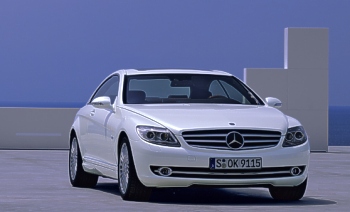
This design idiom lends the Coupé its own particular expressive power, emphasizing the calm and power of its powerful, self-confident nature.
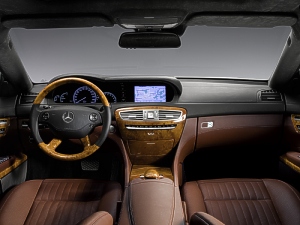
Familiar Mercedes features have been given a contemporary twist, resulting in a harmonious blend of the classic and contemporary. Examples include the hallmark Mercedes radiator grille with its wide chrome louvres and the design of the C-pillar. The unique, slightly downwards-tapering pillar configuration is a typical feature of the large Mercedes Coupés whose roots go right back to the 1950s: in 1956 the 220 S/SE Coupé (W 180/W 128 model series) first captured attention with this striking C-pillar design, and a few years later the concept was further refined in the successor model, the 220 SE Coupé (W 111/112). Other design features which were already acclaimed back then have also been reinterpreted for the CL-Class, keeping alive the large coupé tradition of the Mercedes-Benz brand: the fully retractable side windows, for instance, whose continuous aperture is not interrupted by a B-pillar, and the large, curving panoramic rear window. In the early days this was a typical styling feature of the Mercedes Coupés, and in its stylistically evolved form for the new CL-Class it is just as appealing as in the 220 SE Coupé of 1961. Interior: equipment for even the most discerning driver Style finds its way into the interior too: the large side window aperture draws the eye to the stylish dashboard, exquisite wood trim and soft leather uphol-stery. In an instant you realise that everything in the interior of the new CL-Class is designed for comfort and relaxation. The atmosphere is reminiscent of an exclusive club: take a seat and enjoy. Compared with the outgoing model, the new Mercedes-Benz top-of-the-range coupé has grown slightly in every dimension. 5065 millimetres long, 1871 mil-limetres wide and 1418 millimetres high, the body is 75 millimetres longer, 14 millimetres wider and 20 millimetres higher than before, providing even more comfort and space on all four seats. The boot capacity has been increased by 40 litres to 490 litres (VDA measuring method).
Based on sensor signals and using specially designed hydraulic cylinders at the axles, ABC all but entirely eliminates the customary pitch and roll of the body that oc-cur when moving off, cornering and braking. ABC responds with split-second speed to ensure the body damping is adjusted instantly to any situation. The new luxury Coupé is ready for any challenge on motorways and rural roads thanks to Mercedes’ most powerful engines to date. The eight-cylinder powerplant in the CL 500 delivers 285 kW/388 hp and generates a maximum torque of 530 Newton metres from 2800 rpm. As such the newly developed en-gine outperforms the existing V8 unit by 26 percent in terms of output and 15 percent when it comes to torque. Equipped with four-valve technology, variably adjustable shifting camshafts, a two-stage intake module and tumble flaps in the intake ducts, the new V8 is among the most advanced, powerful engines in its displacement class. The CL 500 accelerates from zero to 100 km/h in just 5.4 seconds (previous model: 6.3 seconds). An ultra-modern biturbo twelve-cylinder engine under the bonnet of the new CL 600 generates its impressive power. Mercedes engineers have enhanced numerous details of the power unit and, compared to the predecessor model, have increased output by 12 kW/17 hp to 380 kW/517 hp. The maximum torque, already on tap from 1900 rpm, has been improved further by 30 Newton metres to 830 Newton metres and remains constant up to 3500 rpm. The new CL 600 accelerates from 0 to 100 km/h in just 4.6 seconds (previous model: 4.8 seconds). The two-door model replaces the world-beating outgoing model, which joins the ranks of the best-selling luxury coupés with around 46,800 units sold. The history of the large Mercedes Coupés stretches back to 1952 when Mercedes Benz launched the legendary 300 S Coupé -- a “car for the world's elite” was the verdict of the motoring press in its day. In 1956 it was followed by the 220 S Coupé as part of the W 180 model series, which fired the public’s imagination with its unitised “Pontoon” body in particular. And in 1961 the220 SEb Coupé (W 111 model series) took up the baton with its stylish elongated body. In 1981 the SEC Coupés from the C 126 model series were based on the then S Class and remained in the Mercedes-Benz line-up for 10 years with over 74,000 units produced. In 1992 the Geneva Motor Show was host to the launch of the successor model (C 140 model series), powered for the first time by a 290 kW/394 hp twelve-cylinder engine. The predecessor to the new CL-Class Coupé celebrated its world premiere in March 1999, setting new standards with leading edge Mercedes innovations such as the Active Body Control (ABC) suspension system and bi-xenon headlamps. Mercedes-Benz has built over 178,000 luxury coupés since 1952. (July 05, 2006)
|
|||||||||