
This Week:
- Announcing
the Toyota InfoTechnology Center
. - Honda
Kicks-Off National Car Care Month With Free Vehicle Inspections
. - Opel's 2001 Engine Strategy - More Power And Lower Emissions
- A
New Dimension Of Built Ford Tough: Ford And King Ranch
. - Covisint Receives Bundeskartellamt Clearance; Automotive Business-To-Business Exchange To Launch Within 30 Days
.
© 1998
- 2000 Copyright &
Disclaimer
Automotive Intelligence,
www.autointell.com
All Rights Reserved .
For questions please contact
editor@autointell.com

News of October 03, 2000
|
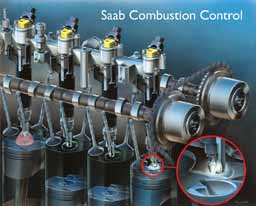
Saab
Combustion Control system: |
|
Photo: Saab |
|
The
Saab Combustion Control (SCC) system is a new engine control system
developed to lower fuel consumption while radically reducing the exhaust
emissions, but without impairing engine performance. By mixing a large
proportion of exhaust gases into the combustion process, the fuel
consumption can be reduced by up to 10 percent, at the same time
lowering the exhaust emissions to a value below the American Ultra Low
Emission Vehicle 2 (ULEV2) requirements that will come into force in the
year 2005. Compared to today's Saab engines with equivalent performance,
this will almost halve the carbon monoxide and hydrocarbon emissions,
and will cut the nitrogen oxide emissions by 75 percent. Three
main components of the SCC concept The
SCC system is based on a combination of direct injection of petrol
(gasoline), variable valve timing and variable spark gap. Unlike the
direct injection systems available on the market today, the SCC system
puts to use the benefits of direct injection, but without disturbing the
ideal air-to-fuel ratio (14.6:1 = lambda 1) necessary for a conventional
three-way catalytic converter to perform satisfactorily. The
most important components of the SCC system are: Air-assisted
fuel injection with turbulence generator The injector unit and spark
plug are integrated into one unit known as the spark plug injector (SPI).
The fuel is injected directly into the cylinder by means of compressed
air. Immediately before the fuel is ignited, a brief blast of air
creates turbulence in the cylinder, which assists combustion and
shortens the combustion time. Variable
valve timing The
SCC system uses camshafts with variable cams to enable the opening and
closing of the inlet and exhaust valves to be steplessly varied. This
allows exhaust gases to be mixed into the combustion air in the
cylinder, which puts to use the benefits of direct injection while
maintaining the value of lambda at 1 under almost all operating
conditions. Up to 70 percent of the cylinder contents during combustion
consist of exhaust gases. The exact proportion depends on the prevailing
operating conditions. Variable
spark plug gap with high spark energy The spark plug gap is variable
between 1 and 3.5 mm. The spark is struck from a central electrode in
the spark plug injector either to a fixed earth electrode at a distance
of 3.5 mm or to an earth electrode on the piston. The variable spark gap
together with a high spark firing energy (80 mJ) is essential for
igniting an air/fuel mixture that is so highly diluted with exhaust
gases. (September 29, 2000) |
[Homepage] [
News] [ Companies] [
Management] [ Publications]
[ Events] [ Careers]
[Services] [Discussion] [
Guestbook]
[ Search]