
This Week:
© 1998
- 2000 Copyright &
Disclaimer
Automotive Intelligence,
www.autointell.com
All Rights Reserved .
For questions please contact
editor@autointell.com

News of March 14, 2000
Making of the Chrysler PT Cruiser
|
|
| Toluca Mexico - The Chrysler PT Cruiser coming off of the
assembly line at DaimlerChrysler Corporation's Toluca Assembly Plant in Mexico is
world-class – not only in the quality of the finished product, but in the skilled
workforce and Operating Principles employed to build it.
|
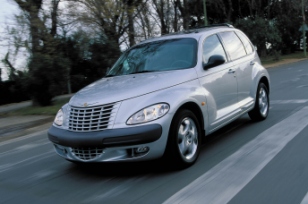
PT Cruiser Photo: DaimlerChrysler |
| When DaimlerChrysler Corporation decided to
produce the segment-busting Chrysler PT Cruiser after receiving rave reviews of the Pronto
Cruizer concept car in 1998, it needed a manufacturing site with sufficient capacity,
flexibility, productivity and a trained work force to bring a high-quality vehicle to
market quickly, at a low cost and with no loss of production during its launch. Faced with this challenge, and operating near full capacity at its manufacturing facilities, the Toluca Assembly Plant met the criteria, plus had the capacity and track-record that made it the ideal location for worldwide Chrysler PT Cruiser production. "Bringing a brand new vehicle, in an all new segment like the PT Cruiser to market quickly - from concept to volume production -- is always an enormous task," said Gary Henson, DaimlerChrysler Corporation Executive Vice-President of Manufacturing. "Although the launch curve is ambitious, we're on schedule and we're shipping product. We haven't lost any production, and we've stayed focused on quality throughout the entire process. It's a success story for the PT launch team in Toluca and in Auburn Hills." Building on the design and development strength established during previous launches as well as other best practices, the company has kept total Chrysler PT Cruiser startup costs below $600 million, including design, development, re-tooling, training, facility improvements, increased automation and pre-production trials. "Bringing the PT Cruiser to market quickly, for relatively low cost is the result of taking advantage of new technologies in development, implementing best practices throughout launch, cutting waste out of the value chain, and using our Operating Principles to efficiently produce repeatable, reliable world-class quality," said Henson. "The goal is to get better with every launch, and we're doing that." Flexible Manufacturing Launch Currently the Chrysler Sebring Convertible, Chrysler Stratus and Chrysler PT Cruiser are assembled in the plant on the same lines, demonstrating the manufacturing flexibility of the Toluca facility. This level of complexity requires additional error proofing measures throughout the manufacturing process. Toluca has the capacity to produce 40 vehicles per hour. As it continues the aggressive production launch, the number of PT Cruisers will steadily increase, as the number of the Dodge Stratus and Chrysler Sebrings decrease. Likewise, the new 2001 Dodge Stratus and Chrysler Sebring sedans, along with the Sebring Convertible will begin ramping up this summer in Sterling Heights Assembly Plant (Michigan) while Stratus and Sebring coupes will be produced in Normal, Illinois. This will bring Sterling Heights to full capacity, while creating additional capacity in Toluca to support additional demand for the Chrysler PT Cruiser. At full production this summer, Toluca will have the capacity to produce about 180,000 Chrysler PT Cruisers annually. Approximately 3,400 team members operate on two shifts at the Toluca plant. Toluca will produce both right and left-hand drive 2.0 liter and 2.4 liter versions for the world market. This is the first right-hand drive vehicle produced in the Toluca plant. In order to reduce the complexity of adding a right-hand drive version, the vehicle was designed to maximize side-to-side symmetry. Additional right-hand drive assembly and testing capabilities were added throughout the plant, including: on-line electrical system testers, radiator and hose installation processes, chassis dynamometers, wheel alignment equipment, seat installation and tool duplication for all operations that vary between the two configurations. Training the Trainers With the challenge of launching an all-new product with such innovative design and complex engineering, team member training was extensive. Production teams from the plant were integrated early in the design engineering verification process. The same teams were trained with the first pilot vehicles developed at the DaimlerChrysler Tech Center (DCTC) Pilot Plant in Auburn Hills, Michigan, in a "train the trainer" process. Core production teams from Toluca, representing every workstation in the plant, rotated to Auburn Hills in six week intervals, over eight months. These core teams then cascaded the information back to the plant. Ultimately one team member per workstation per shift was trained in Auburn Hills before the start of the pre-production vehicle build, representing about 25 percent of the total workforce at Toluca. Each trainer received nearly 500 hours of instruction, for a total of 120,000 hours, and was a crucial part of refining and evaluating production processes. Following the pilot build in Auburn Hills, pre-production vehicles were built on the assembly line in Toluca during normal production. This helped to refine production processes on each station, and to ensure the repeatability and standardization necessary for world-class quality. Running pre-production vehicles in the plant also saved both time and money in product development. Quality Through continuous improvement processes, and its experience in using the company's Operating Principles, the Toluca plant and its workforce have a reputation for producing high quality vehicles at low cost. In fact, Toluca was one of many plants benchmarked by the worldwide DaimlerChrysler manufacturing group in developing best practices for the company's Operating Principles, the comprehensive system it uses to produce vehicles. To ensure quality, the Toluca plant verifies parts, processes and fit and finish every step of the way – from stamping and body, to paint and final assembly. Some of quality assurance processes include:
The Operating Principles Like all DaimlerChrysler Corporation's manufacturing facilities, Toluca conducts its business using the Operating Principles. Rather than merely a way to assemble vehicles, the Operating Principles represent the way the company does business and maintains a lean extended enterprise system. It begins with core values and beliefs, the philosophical principles from which decisions are made. From there, we look at the "how", identifying the enablers and subsystems needed to execute our work (like human infrastructure, balanced schedules, value added activities and robust processes). We then identify ways to support those processes, tools for implementation, and standardized measurements to gauge effectiveness. The Operating Principles give employees at the plant the big picture framework from which to operate, at the same time providing standardized methods and repeatable processes. The end result can be tracked and improved by focusing on Safety, Quality, Delivery, Cost and Morale (S,Q,D,C,M), internal gauges that each team member contributes to. Because continuous improvement is one of the core beliefs, the process never stops. Toluca has embraced the Operating Principles, evidenced in its well-organized workstations, standardized processes, ability to use visual management, efficient material handling, balance of high tech and manual processes and its commitment to training. The Supply Chain PT Cruiser suppliers were integrated in the cross functional teams early in the development process. They participated in the pilot builds at DaimlerChrysler Technical Center, as well as the pre-production vehicles in Toluca, to ensure the same high standards are met throughout the supply chain. The Toluca plant has many of its parts and modules delivered SPD (Sequential Parts Delivery) and just-in-time to the plant. This allows the plant to maintain about a day and a half of inventory, keeping the operation lean and efficient. Several suppliers located operations near Toluca in order to better serve the plant. Depending on the type and amount of components they supply, they either deliver to one of two nearby sequencing centers or directly to the plant. Stamping On Site Toluca Assembly includes a satellite stamping plant on site to help reduce logistics and production costs. With the Chrysler PT Cruiser, Toluca is also using DaimlerChrysler's first compression seam (mash) welding. This enables team members to weld different thickness of steel together and results in better structural rigidity with fewer parts, which, in turn, leads to better dimensional integrity and quality. (March 9, 2000) |
|
[Homepage]
[ News] [ Companies] [ Management] [ Publications] [ Events] [ Careers]
[Services] [Discussion] [ Guestbook] [ Search]