|
May 2013
© 1998 - 2013
Copyright &
Disclaimer
Automotive Intelligence,
www.autointell.com
All Rights Reserved .
For questions please contact
editor@autointell.net
|
|
GMC Pickups 101:
Busting Myths of Truck Aerodynamics
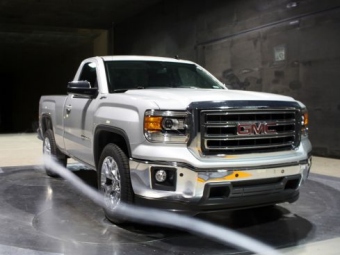
2014 Sierra gains fuel
economy, quietness from time in wind tunnel
DETROIT – The all-new
2014 Sierra full-size pickup truck spent more development time in a wind
tunnel than any GMC pickup before it, resulting in design changes that
benefit both fuel efficiency and interior quietness.
To achieve improved
airflow, aerodynamic engineers like Diane Bloch examined every
millimeter of the truck to find areas of improvement, debunking some
popular myths along the way.
To study the way air
passes over, under and around the Sierra, engineers used General Motors’
state-of-the-art Aerodynamics Lab, a 750-foot-long tunnel through which
a 43-foot-diameter fan powered by a DC electric motor with the
equivalent of 4,500 horsepower can generate winds of up to 138 mph.
Aerodynamic advancement is one reason why the 2014 Sierra will be the
most fuel-efficient V-8 pickup on the market.
|

|
|
|
“We can’t stop air; we can only guide it
through the path of least resistance. It’s like electricity, without the
shock,” said Bloch, GM aerodynamic performance engineer. “The biggest
misconception is that it’s all about single components. But a certain
side mirror design doesn’t create a certain amount of drag, its
interaction with the rest of the vehicle does.”
|
|
For example, a new air dam below the 2014
Sierra’s front bumper successfully reduces drag because it directs air
toward the ground and away from the truck’s rough underbody. And
Sierra’s ducted flow path between the grille and radiator prevents air
from swirling inside the truck’s front cavities.
Even the top of the Sierra’s tailgate and
the center high-mounted stop light are optimized to guide air cleanly
around the truck. And because Bloch’s team detected unwanted airflow
between the cab and bed, new sealing has been added.
“We discovered that in the computational
analysis we perform,” said Bloch. “The most harmful air between the cab
and bed was coming over the cab and down through the gap, so we paid the
most attention to that specific area.”
The pickup market has a great number of
available aftermarket accessories, and Bloch says those have varying
impact on aerodynamics. Add-ons like bug deflectors on the hood, wider
tires or aftermarket bumpers can raise the drag coefficient, which is
the measure of how air pushes on a vehicle as it moves down the road.
The result: added noise and increased fuel consumption.
|
|
A long-disputed topic among truck owners
is whether a tailgate raised or lowered is better for aerodynamics, but
Bloch says a tailgate in the up position is more aerodynamically
efficient. As air flows over the truck, it falls over the cab and pushes
forward on the rear of the truck. With the tailgate down, the benefits
of that airflow are diminished.
“Replacing the tailgate with an
aftermarket net is worse than having no tailgate at all,” Bloch said.
“Imagine dragging a solid object and a fishing net through water. The
net is going to require more muscle.”
So what accessories can truck owners add
to help aerodynamics? Tonneau covers for the bed help smooth airflow
over the truck, and Bloch says soft covers are more beneficial than hard
covers because they form to how the air wants to flow. Running boards
can also help air flow smoothly down the truck’s sides.
“Round, tube-style running boards can
provide a minor improvement to the truck’s drag coefficient,” said
Bloch, “Fully integrated, flush-mount running boards are even better.”
Photo: GM
(2013-05-16)
|

