Ford’s Flexible
Michigan Assembly Plant Makes History by Launching C-MAX Energi Plug-in
Hybrid, Beating Toyota in Fuel Economy Across Lineup
C-MAX Energi is
fifth major advanced technology, fuel-efficient vehicle to be
produced at the transformed Michigan Assembly Plant (MAP) – the
world’s only plant to build gasoline-powered, electric, hybrid and
plug-in hybrid vehicles all on the same production line and the only
one to produce four vehicles delivering 40 mpg or more
After launching the
new Escape, Fusion and C-MAX hybrids, Ford now beats Toyota in fuel
economy in every segment where both compete
The C-Max Energi is
America’s most fuel-efficient and affordable plug-in hybrid vehicle,
delivering 108 MPGe city and “real car” horsepower of 195, eclipsing
the Prius plug-in by more than 60 horsepower
MAP’s five fuel
economy leaders, coupled with the all-new Fusion Hybrid and Fusion
Energi plug-in hybrid and the nearly half a million EcoBoost-powered
vehicles sold globally, cements Ford’s fuel economy leadership
position in 2013
WAYNE, MICH. – Ford’s Michigan Assembly
Plant is making history with each new C-MAX Energi plug-in hybrid that
rolls off the line. It is the only manufacturing site in the world to
build vehicles with five different fuel-efficient powertrains on the
same line and the only one to build four vehicles that deliver 40 mpg or
more in real-world driving.
Ford is committed to deliver eight
vehicles for U.S. customers by year-end that deliver 40 mpg or more – a
claim no other full-line automaker can match. MAP builds half of those –
C-MAX Energi, C-MAX Hybrid, Focus Electric and Focus SE with SFE –
helping Ford complete a lineup that now beats Toyota in fuel economy in
every segment where they both compete
“Michigan Assembly Plant is setting a new
global standard for flexible manufacturing, and is a central part of
Ford’s important milestone, sweeping Toyota across the board for fuel
economy leadership,” said Jim Tetreault, Ford vice president of North
America Manufacturing. “The transformation of this plant is proof of how
our One Ford plan has transformed our products, giving our customers
industry-leading choices for hybrids, plug-ins, electrics and EcoBoost-powered
vehicles.
Converted from a plant that produced two
full-size SUVs, MAP is now the only factory in the world to build
gasoline-powered, electric, hybrid and plug-in hybrid vehicles on the
same production line. MAP produces the following vehicles that offer
Ford customers a range of fuel- efficient options versus Toyota and
other competitors:
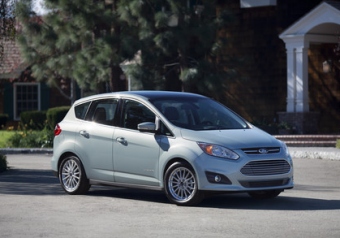
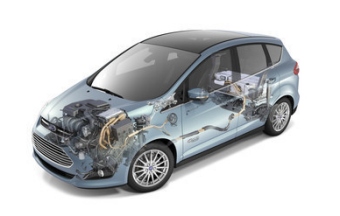
C-MAX Energi – America’s most
fuel-efficient and affordable plug-in hybrid vehicle – is on its way
to Ford EV-certified dealers in half the states across the country.
As Ford’s first production plug-in hybrid, C-MAX Energi provides
customers with an all-new electrified vehicle offering that delivers
a class-leading 108 MPGe city EPA rating, “real car” horsepower of
195 (versus Prius plug-in’s 134 horsepower) and a leading EV-only
speed of 85 mph, 20 mph above the Prius plug-in.
C-MAX Hybrid – The country’s most
fuel-efficient and affordable hybrid utility vehicle is now the
best-selling hybrid utility vehicle after outselling Toyota Prius v,
3,182 units to 2,769 units, in just its first full month of sales in
October. C-MAX Hybrid delivers EPA-certified 47 mpg city, 47 mpg
highway ratings – 7 mpg better than the Toyota Prius v on the
highway – for a 47 mpg combined rating – plus more performance and
technology.
Focus Electric – Officially America’s
most fuel-efficient five-passenger car, with a certified 110 miles
per gallon equivalent (MPGe) city rating and 99 MPGe on the highway.
Focus Electric, a zero-emission battery electric vehicle, also has
been certified by the EPA to offer 105 MPGe combined, beating Nissan
Leaf by 6 MPGe while offering more motor power and more standard
features.
The Focus ST – Its new 2.0-liter
EcoBoost® four-cylinder engine is certified at 32 mpg highway –
better than its manual-equipped competition in the Volkswagen GTI
and MazdaSpeed3.
Focus with the SFE (Super Fuel
Economy) package – This sleek small car delivers an EPA-certified 40
mpg on the highway and 28 mpg city through its advanced six-speed
automatic transmission.
Four years ago, Ford’s Manufacturing and
Product Development teams began working together to develop product
platform designs that enable the use of programmable equipment to
produce multiple variations of products in one facility. Today, more
than 80 percent of the tooling in the plant’s body shop can be
programmed to weld a variety of body styles. This allows Ford to quickly
adjust the mix between models as customer preferences change.
In the final assembly area, Ford
Manufacturing engineers collaborated closely with UAW representatives to
design job stations that can be adapted to different kinds of work
content, depending on the vehicle. For example, even though C-MAX
vehicles have 1,074 separate parts from the Focus, both vehicles travel
through nearly all of the same 604 workstations in the trim and chassis
areas.
Several workstations play key roles in the
plant’s ability to build both electrified and gasoline-powered cars.
In chassis, workers at one station
have plastic fuel tanks on one side of the line and electric
chargers on the other. Depending on the build sequence, they install
either a charger in a Focus BEV, or a fuel tank in a C-MAX or
gasoline-powered Focus.
Several stops further down the chassis
line, other workers attach either battery packs or exhaust systems,
depending on the vehicle.
In the trim area, multiple stations
have been reconfigured so that a team of workers has a longer time
window to do the complicated functions of installing a high-voltage
wire and battery into C-MAX or Focus BEV, while being given quicker
tasks to perform when gasoline-powered Focus cars come down the
line.
In addition to the $550 million that Ford
invested to convert MAP into a flexible factory, the company added a
third crew of 1,200 workers in May, bringing total employment to 5,170
workers.