|
“People expect Jaguar to be innovators - that is when Jaguar
is at its best,” said Adrian Hallmark, Jaguar Brand Director.
“The C-X75 received an incredible reception as a concept car.
We’ve been building on that momentum and there is a clear
business case for this exclusive halo model. No other vehicle
will better signify Jaguar’s renewed confidence and excellence
in technological innovation than this.”
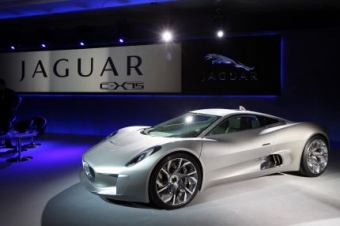
Project C-X75 will be the ultimate expression of Jaguar
design and engineering innovation. This high-performance hybrid
supercar will stay true to the initial concept design study that
made its debut at the 2010 Paris motor show, while fulfilling
requirements that allow it to be homologated for road use.
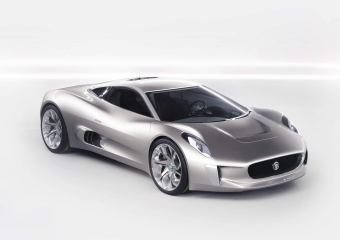
“We were always determined that the Jaguar C-X75 would be as
striking on the road as it was in concept form,” said Ian
Callum, Director of Design, Jaguar Cars. “This will be the
finest looking and most innovative Jaguar ever produced. Even in
the world of supercars, we can still produce the most
beautiful.”
In an unprecedented move, Jaguar C-X75 will be developed in
association with Williams F1 who will provide their engineering
expertise in areas including aerodynamics, carbon composite
manufacture and hybrid technologies. This association will be at
the leading edge of British automotive engineering and
innovation.
“Confirmation of this project today signposts Jaguar Land
Rover’s continued determination to embrace new technologies,”
said Jaguar Land Rover CEO, Dr Ralf Speth. “A supercar like the
C-X75 is the logical choice to showcase cutting-edge design,
intelligent use of new environmental technologies and
motorsport-inspired performance.”
It also marks a new milestone in both company’s histories as
Jaguar Land Rover and Williams collaborate for the first time to
produce one of the world’s highest performance and
environmentally sustainable supercars. The production of Jaguar
C-X75 will create more than one hundred highly-skilled jobs in
the UK.
A direct technology transfer between elite motorsport and
road-going production cars is key to C-X75’s success. The
supercar’s chassis will be made of carbon-fibre to create an
incredibly lightweight, yet rigidly strong structure.
Aiding the transition from concept to production vehicle is
the choice of powertrain. Jaguar continues to develop the use of
the micro-turbine technology that was showcased in the original
concept C-X75. Jaguar’s parent company Tata has taken a
significant stake in Bladon Jets, and will develop this very
advanced technology as a medium-term aspiration that will play a
part in Jaguars of the future.
To bring Project C-X75 to showroom reality within the
timescales of a conventional model programme, an equally
innovative powertrain had to be developed. The road-going
supercar will use a state-of-the-art, small-capacity,
highly-boosted internal combustion engine with one powerful
electric motor at each axle.
“The engine’s compact size allows it to be mounted low in the
car for optimum weight distribution and to retain the concept’s
stunning silhouette. This will make the Jaguar C-X75 a bona fide
hybrid supercar capable of silent electric running with an
extensive EV range in excess of 50km,” explained Bob Joyce,
Group Engineering Director, Jaguar Land Rover.
When C-X75’s motors and combustion engine combine, it will be
one of the fastest production cars in the world, with a
sub-three second 0-60mph time and a top speed in excess of
200mph. Crucially, this performance will be generated alongside
incredibly low emissions, with a target of less than 99g/km CO2,
thanks to Project C-X75’s lightweight construction and
cutting-edge powertrain technology.
Williams F1 has been at the forefront of motorsport
engineering for three decades. The project engagement on Jaguar
C-X75 is testament to the team’s ambitions and will bring
together two leading lights of the UK motoring industry.
“Our new association with Jaguar Land Rover provides us with
an exciting opportunity to work with one of the motoring world’s
most famous and iconic brands,” said Sir Frank Williams,
Chairman of Williams F1. “Williams has always considered itself
an engineering company and so this project will allow us to
combine our technical expertise to create something truly
exceptional.”
Jaguar C-X75 will redefine the customer experience, and will
set new standards in sales and after-sales services that will be
recreated across the range in the future. Only 250 examples will
be built, each costing between £700,000 - £900,000 depending on
market and local taxes.
“Never before has the company launched such an ambitious,
world-beating vehicle programme,” said Carl-Peter Forster, CEO
Tata Motors. “This is the Jaguar of the future. The opportunity
for innovation like this in the UK is part of the reason Tata
Motors invested in Jaguar, and it’s fantastic that products like
the C-X75 can become reality.”
Photos: Jaguar
(6 May 2011)
|