|
The stand-out feature of this unique engine, developed exclusively
for the BMW M5 and BMW M6 models, is power delivery that is both
extremely dynamic and smooth even at higher loads. Output is developed
from a 5-litre displacement split between ten combustion chambers, with
the two banks of cylinders cranked at 90 degrees to one another. The
engine delivers maximum output at 7,750 rpm, with engine speed
eventually peaking at 8,250 rpm, and it has maximum torque of 520 Nm. In
addition to the high-rev concept, a number of other technological
details – electronically-controlled individual throttle valves, an ionic
current control system and lateral force-controlled oil supply – were
also directly derived from motor racing.
In much the same way, design principles of chassis technology and
lightweight construction also found their way from the race track to the
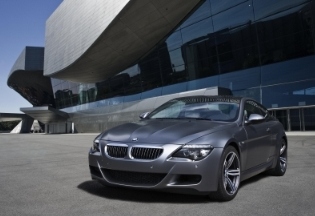
road. In the case of the BMW M6 Coupé, for example, carbon fibre-reinforced
plastic (CFRP) – a material that largely owes its introduction in the
automotive sector to Formula One – was used in both the roof and bumper
design. Its power-to-weight ratio of 3.37 kilograms per hp is another
unbeatable key indicator in the profile of the BMW M6 Coupé. Moreover,
its outstanding performance characteristics are additionally supported
by seven-speed SMG Drivelogic and Launch Control for maximum
acceleration from a standing start, the speed-sensitive variable M
differential lock, and model-specific chassis technology, including
Electronic Damper Control (EDC) and compound brakes. Standstill to 100
km/h acceleration time is a mere 4.6 seconds. The BMW M6 Convertible
takes just 0.2 seconds longer, giving the driver time to appreciate not
only the thrilling dynamic performance but also the irresistible flair
of an open-top premium sports car in the luxury class.
The BMW M6 Coupé and BMW M6 Convertible received worldwide acclaim as
dream cars for automotive enthusiasts with sporting ambitions. The
number one market for both models was the US, which recorded sales of
3,528 closed and 3,247 open-top vehicles, followed by Germany (1,183 /
541 units). In third position for sales of the BMW M6 Coupé came Great
Britain and Ireland, with 619 vehicle registrations; in the case of the
BMW M6 Convertible it was Canada, with 209 units sold.
Sales of the BMW M5 followed a similar pattern. The United States
once again came out on top, with sales of 8,786 vehicles. Then, after
the domestic market of Germany (2,473 units), Great Britain and Ireland
generated the next highest demand on the continent of Europe, with 1,980
vehicles. In total the BMW M5 recorded global sales of over 20,000 cars
in under five years, with current figures of 19,494 units for the BMW M5
Saloon and a further 1,009 units for the BMW M5 Touring, available since
2007.
The total combined figures for the fourth-generation BMW M5 exceed
even those of its predecessor model, which was in production for six
years. With that it has secured the current high point in the success
story of the BMW M5, the first generation of which established the
vehicle segment of high-performance saloons at its introduction in 1984.
Photos: BMW
(Sept. 14, 2010)
|
|