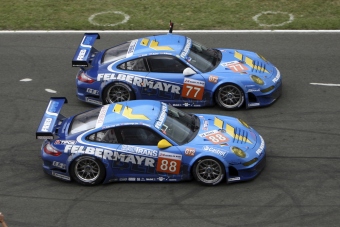
|
“It’s giving the right signal to
place more importance on the efficiency of a racing car,” says
Hartmut Kristen, Head of Porsche Motorsport. “Winning the Green
X Challenge, which is a very important success for us, proves
that the Porsche 911 is not only fast, but also very
economical.”
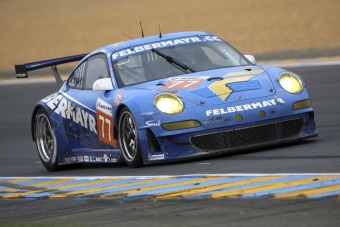
In its current form, the Porsche
911 GT3 RSR of the 997 type has been sold to international
customers since 2007. From year to year, the top model of 911
racing vehicles received ongoing modifications. The most
conspicuous changes were made to the 2009-model. The capacity of
the six-cylinder boxer engine at the rear grew from 3.8 to
4.0-litres, resulting in an optimised torque curve at reduced
revs as well as better driveability. The most distinguishing
feature of the still current 911 GT3 RSR is the redesigned front
section with a large ventilation opening. Noticeable at first
sight are the air outlet slots, the so-called louvers, on the
front hood. They are an indication of the completely revamped
air ducting of the radiators, which became necessary through the
new design of supply and discharge air with the installation of
an optional air-conditioning unit. The aerodynamics under the
rear underwent further optimisation. The rear wing now features
a wider adjustment range. Compared to the 2008-model, the
weight-optimised brake system and the lighter wiring harness
contribute to further improved driving dynamics.
A great deal of know-how from the
successful RS Spyder sports prototype went into the gearbox of
the 911 GT3 RSR. The sequential six-speed gearbox developed by
Porsche engineers is considerably lighter than the unit fitted
in the predecessor and has much less internal friction. The
flatter angle to the drive shafts allow teams greater scope for
the suspension set-up.
The foundation for today’s
successes was already laid with the racing variants of the
Porsche 911 996 type. Built to contest the GT class of the Le
Mans 24 Hours, the 911 GT3 R clinched virtually all GT class
wins in the 1999 American Le Mans Series. In 2001, the modified
911 GT3 RS version was raced. This vehicle was not just
successful in its class, but also celebrated prestigious overall
wins, with the two German Porsche works drivers Joerg
Bergmeister and Timo Bernhard an team owner Kevin Buckler
beating significantly more powerful prototypes at the Daytona 24
hour race in 2003. Porsche factory pilot Marc Lieb (Germany) won
the 24 Hours of Spa with Romain Dumas (France) and Stéphane
Ortelli (Monaco) in the same year beating all the much more
powerful GT1 cars.
In the 2004 season, the successor
model 911 GT3 RSR (996) made its debut. The output of its
3.6-litre six-cylinder boxer engine increased to 455 hp (335 kW)
at 8,500 rpm, the maximum torque to 410 Nm at 7,200 rpm. By
winning the American Le Mans Series (GT class), the Le Mans
Endurance Series (GT) as well as the FIA GT Championship (N-GT),
as well as class victories at the Le Mans and Spa 24 hour races
and the Petit Le Mans event, the new racing sports car
celebrated a brilliant debut season.
“It’s impressive how the 911 GT3
RSR has developed from year to year. The lap times alone are
astounding, because despite the restrictions imposed on us again
and again by the regulations, the car just got faster every
year,” says Porsche works driver Joerg Bergmeister, who
celebrated the majority of his successes at the wheel of the RSR.
For this reason, the five-time winner of the American Le Mans
Series is not at all anxious about tackling the 2011 season:
“When you finish a season you always think: now we’ve reached
our limit, now the car’s gone as far as it can go. And then
Porsche comes up with something new again. And I reckon it won’t
be any different in 2011.”
Photos: Porsche
(Oct. 14,2010)
|
|