Last year Mazda wowed the show car
world with a trilogy of design concepts that were talked about
on three continents. From Europe’s Sassou show car with its
unique Shoji design principle and hidden features, to Tokyo
Motor Show’s Mazda Senku concept car, winner of the Grand Prix
du Plus Beau Concept Car at the XXIst Festival Automobile
International in 2006 in Paris, to North America’s sports car
study Mazda Kabura, winner of the Detroit Motor Show’s Aesthetic
and Innovation Award –Mazda Motor Corporation wrote another
chapter in its global reputation for eye-catching, Zoom-Zoom
designing.
The new show car season features
four concepts from Mazda that express a new design language
called Nagare, (pronounced na-ga-reh) developed by Mazda’s new
global design director, Laurens van den Acker. The word Nagare
means “flow” and “the embodiment of movement” in Japanese and
applying it to car design involved analyzing motion itself and
how forces like wind and water move in nature. Natural flow
lines are all around us –wind blowing shapes in sand, wave forms
seen from above –and are literally symbolic of movement itself.
Nagare, then, is the application of natural flow to automotive
design that combines surface language and proportion to
communicate movement in a new way.
.
Its first expressions were the
Mazda Nagare concept car presented last November at the LA Auto
Show, and the Mazda Ryuga, which premiered at the Detroit Motor
Show this January. Both Mazda concepts are an evolving
expression of Zoom-Zoom, inspired by the movement of nature’s
elements –Mazda Nagare’s surface articulation was inspired by
geological flow patterns, and Mazda Ryuga’s side body texture
was inspired by Karesansui, or Japanese raked gardens. Both
evoke energy and lightness, translated into a beautiful language
of lines and forms that are powerful yet effortless, simple yet
strikingly seductive.
Now Nagare is coming to Europe
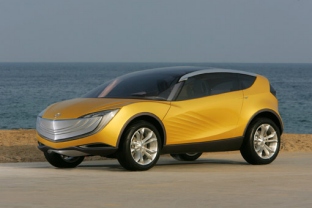
with this season’s third all-new concept car, the Mazda Hakaze,
which was designed at Mazda’s European Design Centre near
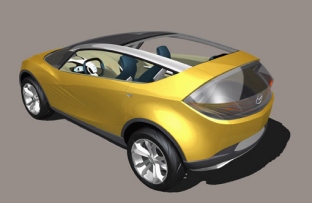
Frankfurt, Germany. Mazda Hakaze is a compact crossover coupe
with roadster feel. It combines the best attributes of three
traditional types of cars. Part of its roof is removable, which
gives a feel similar to a roadster; it is agile and fun to drive
like a compact hatchback, and it has a high hip point and
interior functionality like a compact SUV. It expresses Nagare
“flow” on the outside with sand-dune like surface iteration, and
combines these with shapes from machines that move through water
or air. On the inside, it boasts “flowing”Nagare forms, natural
surfaces and insightful functionality to meet the demands of
adventurous lifestyles like kite-surfing.
Photos: Mazda
“Nagare is expressed in the Mazda
Hakaze, not only in the iteration on the side of the car, but
also in a lot of the details,” says Peter Birtwhistle, Chief
Designer, Mazda Motor Europe.”If you look at things like the
execution of the wheel design, the spokes have a nice flow in
terms of the way they move, the way the surfaces move, the way
they integrate into the tyre design. The interior too. The basic
form of the interior is like looking at sand dunes. It’s got all
this movement, winds blowing. I find that inspirational in terms
of trying to find a new way of expressing design. Of course, you
have to think about functionality. But Mazda is all about
emotion. And this is emotion.”