|
|
 |
 |
||||||||
|
September 13, 2006 This Week:
© 1998 - 2006
Copyright & |
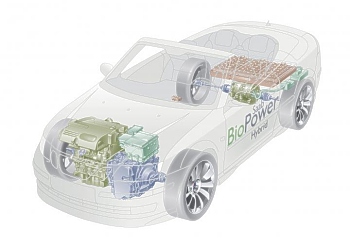
The BioPower engine operates in tandem with a sophisticated electric power system, comprised of the two-mode hybrid transmission, a rear-drive unit (RDU), a 300-volt battery and sophisticated electronic control.
Two-Mode hybrid technology The Saab BioPower Hybrid Concept showcases the state-of-the-art two-mode hybrid transmission. This sophisticated technology represents a major industry milestone, achieving an unprecedented level of integration by combining two electric motors and four fixed gears within a single transmission housing. Commonly described as a two-mode hybrid due to the low- and high-speed electric continuously variable transmission (ECVT) modes, the fuel-saving technology also incorporates four fixed gear ratios for a total of six operating functions. The result is trend-setting hybrid technology that provides superior fuel economy, performance and load carrying potential. The two-mode hybrid’s electric motors can be used for electric-only propulsion, boosting the internal combustion engine and providing regenerative braking. Additional fuel-saving efforts include removing auxiliary functions, such as the water pump, air conditioning and power steering systems, from the engine's belt drive and transferring them to electric power through the hybrid system. The two-mode hybrid transmission is similar in size to a conventional automatic transmission. Its adaptable design allows it to be scaled to the size, mass and performance needs of various engines and vehicles. BioPower propulsion The Saab 9-5 2.0t BioPower, which is capable of using E85 fuel (85% bioethanol/ 15% gasoline), is an outstanding success in Sweden, where it is currently the best selling flex-fuel vehicle. The Saab BioPower Hybrid Concept now advances Saab’s alternative fuel technology by adding an E100 capability. The engine is a BioPower evolution of the current all-aluminum, 16-valve 2.0-liter turbo engine in the Saab 9-3 range. Utilizing the higher octane ratings offered by E100, it develops 260 hp and an impressive 375 Nm maximum torque, an increase of 24 percent and 25 percent, respectively, compared to its gasoline-only equivalent. A Spark Ignited Direct Injection (SIDI) system provides optimum combustion with E100, ensuring the same cold starting performance as a gasoline engine. Variable inlet and exhaust cam phasing is used for optimum air flow and more durable valves and valve seats are fitted, together with bioethanol-compatible materials for the fuel system. Hybrid architecture An integrated hybrid operating system has been adopted, where the control strategy is based on efficient 'energy management' – recovering and storing energy that is otherwise lost in a conventionally powered vehicle. Apart from converters to manage AC/DC and 12 and 300-volt interfaces, there are three core components: the two-mode hybrid transmission, with two electric motors (described above), an electric Rear Drive Unit (RDU) with a third motor, and a 300-volt battery. The RDU features a 38 kW motor, located between the rear wheels, which powers a transmission differential and drive shafts. Under acceleration at low speeds, the RDU is able to briefly generate 665 Nm of additional torque. The motor is also configured to provide regenerative braking and energy recovery from the rotating drive shafts during deceleration. Energy storage for all three electric motors is provided by a high capacity 300-volt lithium-ion battery with fan cooling. This is neatly packaged under the floor of the trunk, without eliminating storage space. Battery performance is carefully monitored and governed by a dedicated electronic control unit. Saab BioPower Hybrid Concept: Technical data:
(September 12, 2006)
|
||||||||