Mercedes-Benz E 320 BLUETEC begins the
Diesel campaign in the USA
To coincide with the conversion of
up to 76,000 US filling stations to clean Diesel fuel with a
sulphur content below 15 ppm, Mercedes Benz is commencing sales
of the E 320 BLUETEC in the USA and Canada in one week’s time.
Ultra Low Sulphur Diesel (ULSD) allows the use of trail-blazing
BLUETEC technology, making the E 320 BLUETEC the world’s
cleanest Diesel car.
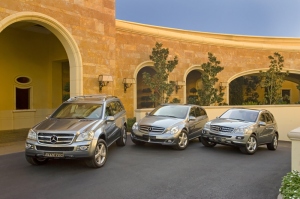
Photos: Mercedes-Benz
The E 320 BLUETEC is the first and
only Diesel vehicle worldwide able to better the American BIN 8
exhaust emissions standard, which is extremely stringent –
particularly in terms of nitrogen oxide emissions. The E 320
BLUETEC will be available for sale in the USA (45 states) and
Canada, and uses up to 30 percent less fuel than comparable
petrol-engine vehicles in North America. Owing to its enormous
operating range of up to 1200 km on one full tank, the E 320
BLUETEC is exceptionally well cut-out for US driving conditions.
The latest J.D. Power study "Global Outlook For Diesel"
forecasts that Diesels will account for more than 15 percent of
new registrations in North America by 2015. In the light of
this, Mercedes-Benz will systematically expand its BLUETEC
range. The company has announced that it intends to offer three
further BLUETEC models in the R, ML and GL-Class - meeting the
even more stringent BIN 5 standard - in all 50 US states as
early as 2008.
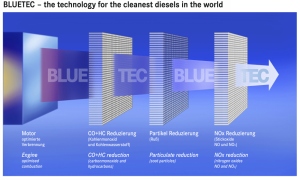
BLUETEC is a modular
emissions control system that reduces nitrogen oxide
levels. These are the only exhaust components from
Diesel engines which, due to the principles of Diesel
engineering, still exceed the levels in petrol units.
Mercedes-Benz has developed two versions of BLUETEC: in
the E-Class an oxidation-type catalytic converter and
particulate filter are combined with an improved,
extremely durable NOx trap system and an additional SCR
catalytic converter.
The second BLUETEC version is even
more efficient. Here, AdBlue, a non-toxic aqueous solution, is
injected into the exhaustgas stream, causing ammonia to be
released. In the downstream SCR catalytic converter the ammonia
then converts up to 80 percent of the nitrogen oxides into the
harmless natural products of nitrogen and water. The specific
vehicle concept and weight as well as the deNOx requirements
determine which BLUETEC system is used.
From October 21 this BLUETEC technology
will be subjected to an endurance test of a very special kind, when 33
E-Class cars including three E 320 BLUETEC models embark on a journey
from Paris to Peking. Over the course of 26 days each of these vehicles
will cover 13,600 kilometres under extreme conditions on a journey which
will take them across eight national borders.