|
|
 |
 |
||||||
|
December 6, 2006 This Week:
© 1998 - 2006
Copyright & |
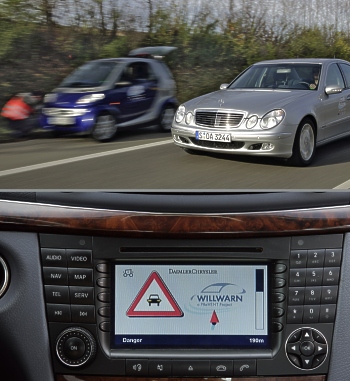
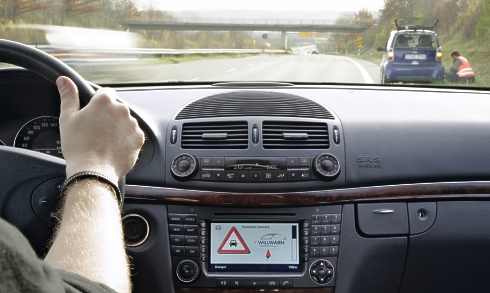
One of the key benefits is that expensive, fixed-installation transmitting and receiving devices are not required, since the cars themselves act as both transmitters and receivers. The cars establish an ad-hoc radio network and send any necessary warnings to all other vehicles within a radius of around 500 metres.
For vehicles outside of this radio range, the cars act as relays and pass on any warnings in much the same way as a relay runner would hand over a baton. No additional sensors are required to detect critical situations, since the necessary information is provided by the anti-lock braking system (ABS), the Electronic Stability Program (ESP®), the steering-angle sensors, the outside thermometer or the navigation system. The DaimlerChrysler engineers incorporated the key groundwork laid during the course of the "FleetNet" project into the subsequent "NOW" (Network On Wheels) programme (a German cooperation project) and the current "WILLWARN" project. Their aim was to use the experience gained to work together with partners from the automotive components and electronics industries in order to further develop and standardise this promising technology whilst also securing the rights to use the required frequencies. Radio beacons at the side of the road are required in order to ensure that the first vehicles to be equipped with such a system benefit immediately. These stationary radio nodes could also be used to provide traffic control centres with additional and better information. However, direct contact with the Internet and its numerous fields of application is also possible. In addition to warning motorists of critical situations in advance, the new radio network could therefore also be used to improve the flow of traffic: communicating cars could guide their occupants away from traffic congestion or even prevent tailbacks from occurring at all. DaimlerChrysler was also one of the instigators behind the European "Car2Car Communication Consortium" and is involved in the American Vehicle-Infrastructure Integration Initiative. These projects lay the political foundations for vehicle communication in Europe and America and have the aim of accelerating the process of standardisation. (December 04, 2006)
|
||||||