|
|
. . 
|
||||||
|
October
19, 2005
© 1998
- 2005 Copyright & |
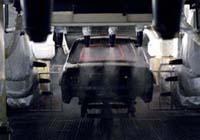
And 24 million pounds of paint overspray are captured in spray booths, treated and consolidated into nonhazardous sludge that eventually finds its way to landfills “Painting vehicles is arguably the auto industry’s biggest challenge,” said Mary Ellen Rosenberger, manager, Paint Strategy, Ford Motor Company. “Ford has found the solution. It’s environmentally sound. It’s cost-efficient. And it produces beautifully painted vehicles with long-term durability.” Ford’s Paint Shop of the Future consists of three major technological solutions: an advanced chemical paint formulation, an innovative three-wet application process and patented waste management technology that converts paint fumes into electricity and recycles paint sludge into car parts. The new paint shop will be piloted at Ohio Assembly Plant early next year. Advanced Chemical Formulation Ford and its suppliers have developed a patented high-solids, solvent-borne paint formulation that produces fewer VOC emissions than do current water-borne and solvent-borne paints. The new formulation contains more color pigment and, therefore, requires less paint to cover a vehicle. Furthermore, it contains new polymers and other additives that prevent running and sagging. According to Ford internal quality data, solvent-borne paint provides better long-term resistance to chips and scratches than does water-borne paint. Three Coats of Wet Paint A patented three-wet paint process allows Ford to eliminate one of the five steps in the paint shop, resulting in a total estimated cost savings of $7 per vehicle. Furthermore, the smaller paint shop consumes less energy, resulting in fewer C02 emissions. In the new paint shop, the prime-coat application and its related processes are eliminated. Three coats of wet paint are applied one after another without sags, runs and other defects – thanks to the new chemical formulation.
Waste Management Ford is not only interested in managing waste, but eliminating it. Innovative technology, such as the patented Fumes to Fuel, nonhazardous sludge recycling, and high-transfer efficiency are among the methods Ford is currently using. A new bell-shaped spray applicator minimizes overspray. As a result more paint adheres to the vehicle. Even with more efficient applicators, there is overspray – which is consolidated into nonhazardous sludge. Ford is installing a recycling system at Michigan Truck Plant in Wayne, Mich., that dries the sludge and recycles it into auto parts that help quiet the passenger compartments of cars and trucks. Instead of going to the landfill, the sludge is recycled into a liquid-applied, sound-deadening material, called LASD. Michigan Truck Plant also features a permanent installation of Ford’s patented Fumes-to-Fuel technology, which turns paint fumes into electricity that is returned to the plant power grid. It’s enough electricity to light a typical suburban block of homes. The permanent installation follows a successful pilot of the technology at the Ford Rouge Center in 2004. VOCs are pulled from the paint air emissions by carbon beads. The clean air is then released from the facility. The scrubbed VOCs are sent to a generator where they are transformed into electricity. (Oct. 13, 2005)
|
|||||