|
|

|
||||
|
June
01, 2005
© 1998
- 2005 Copyright & |
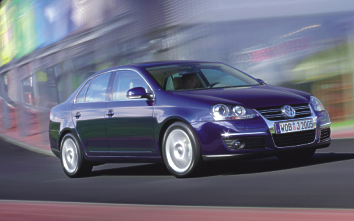
Design - new face, new dynamics The new Jetta's most dominant design feature is the front end with its chrome radiator grille. With its new face, the fifth generation of this model reflects its claim of being considerably more independent, sporty and refined. In stylistic terms, the V-shaped radiator grille consciously reveals its proximity to the new Passat and the Golf GTI, the brand's first two series models with the new "VW face". The result is that the front end is contoured more sharply and is therefore more dynamic and elegant than ever before. The rear end is also striking: its style also reflects the current VW design line and reveals the very fast-acting LED lights which have already become almost a typical Volkswagen feature. Exterior dimensions - new size, new class The switch from the Bora to the Jetta not only involves a major design leap, but also an increase in interior and exterior dimensions. The new Jetta is 4.55 metres long (+ 17,8 cm), 1.78 metres wide (+ 4,6 cm) and 1.46 metres high (+ 1,3 cm). Along with the vehicle's length, its wheelbase has been extended to 2.58 metres (+ 6.5 cm). Interior dimensions - more space in the rear, 527-litre luggage compartment The exterior dimensions have been increased almost entirely to the advantage of the interior and therefore the maximum of five passengers in the Jetta. In the rear, for example, the effectively useable leg room has been increased by 5 centimetres and head room by 2.4 centimetres. The Jetta's traditionally large luggage compartment has reached enormous proportions: it now offers 527 litres of luggage space, 72 litres more than its predecessor. The rear bench seat backrest can be folded 1/3 to 2/3 as standard to form a continuous and almost flat cargo area extension. Basic price / basic equipment - more equipment, less money The new Jetta will be available with seven engines (four petrol engines, three turbodiesel engines, with outputs ranging from 75 kW to 147 kW) and in three equipment lines (Trendline, Comfortline and Sportline). The saloon's price/performance ratio is one of the best the segment has to offer. With standard features such as a semi-automatic air conditioning system (Climatic), ESP, six airbags, active front headrests, electromechanical power steering, electric window lifters (4-fold), central locking with radio remote control, electrically adjustable and heated outside rear-view mirrors, dash panels, door trims and centre console manufactured from high-quality plastics painted with soft-effect paint, even in lower areas, and 205 dimension tyres (16"), the new Jetta fitted with the basic engine (1.6, 75 kW / 102 hp) and equipment (Trendline) will cost euro 18,950 in Germany. Despite significant, further, technical developments, the vehicle's price has therefore been reduced by euro 350 versus a comparably equipped predecessor vehicle with similar output. Traditionally, the Jetta additionally offers more individual and extensive, basic equipment than a comparable Golf. Engines - seven engines, six direct injection engines Besides the basic engine, the Jetta will exclusively be fitted with direct injection engines (FSI and TDI). The petrol engines offer outputs of 85 kW / 115 hp (1.6 FSI) and 110 kW / 150 hp (2.0 FSI). A 147 kW / 200 hp 2.0 turbocharged FSI engine, which is currently causing a stir in the Golf GTI, will follow as the top engine. These three FSI engines are rounded off by three TDIs with outputs of 77 kW / 105 hp, 103 kW / 140 hp and 125 kW / 170 hp (the latter will be launched at a later date). The TDIs and the turbocharged FSI will be optionally available with the highly-efficient and sporty double-shift gearbox DSG (automatic, pulling power not interrupted during shifting, no negative influence on consumption and performance). An optional six-speed automatic gearbox will also be available for the 75 kW and 110 kW petrol engines. As of autumn 2005, it will additionally be possible to order the new Jetta with a diesel particulate filter. International - markets and Mexico Ranked in order of volume, the Jetta's ten most important markets outside of Germany and the USA are Great Britain, Turkey, Austria, Spain, Italy, France, the Netherlands, Belgium, Australia and Sweden. The subsequent five places are occupied by Poland, Japan, Ireland, Hungary and Finland. The new Jetta will be built in VW's Mexican plant in Puebla, employing state-of-the-art production methods: for example, the body will be manufactured using extensive laser welding technology and high-strength grades of steel. In comparison with the predecessor, the length of laser-welded joints has increased 14-fold. The dual-percent increases in static and dynamic body stiffness values are not least attributable to this factor. (May 25, 2005)
|
|||