|
.
News from Zuffenhausen: The 911 Carrera 4
Cabriolet and the Carrera 4S Cabriolet
Open-air duo with
all-wheel technology
Stuttgart - Dr. Ing. h.c.
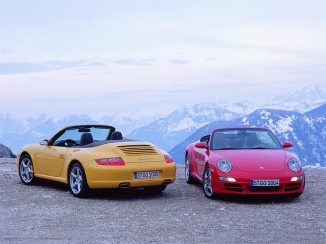
F. Porsche AG, Stuttgart, presents a new generation of open 911 versions
with all-wheel drive. The market launch of the new 911 Carrera 4 and 911
Carrera 4S Cabriolets in Europe takes place on October 22, 2005.
The Carrera 4 Cabriolet
is powered by the familiar 3.6-liter six-cylinder boxer engine, which has
an output of 239 kW (325 bhp). The open all-wheel-drive sports car
accelerates from 0 to 100 km/h in 5.3 seconds and reaches a top speed of
280 km/h. The 4S model is powered by the equally well-proven 3.8-liter
engine, which has an output of 261 kW (355 bhp). This model sprints to 100
km/h in 4.9 seconds and has a top speed of 288 km/h.
As is already the case
with the coupé version of the Carrera 4, power transmission in the
Cabriolets is by all-wheel drive with a Visco multi-plate clutch, which
consistently brings between five and 40 percent of the driving power to
the road via the front wheels.
The body shell of the new
open sports car models is 44 millimeters wider than on the
rear-wheel-drive 911 Cabriolet, and due to its high degree of stiffness it
combines the joy of open-top driving with the dynamics and driving
stability of all-wheel drive. At the touch of a button, the fabric top
opens and closes automatically in only 20 seconds at speeds of up to 50
km/h. At 42 kilograms, the convertible top weighs barely half as much as a
comparable Vario folding roof, thus providing a lower center of gravity
and a higher degree of lateral dynamics.
The new Cabriolets’
anti-roll-over system consists of super high strength steel tubes in both
A-pillars, and two automatically extending bars behind the rear seats. Two
head airbags complement the passive safety system. These are located in
the door panel in the form of flat cushions that inflate upwards in the
event of a lateral collision. This means that they provide a unique form
of protection for the head, even when the top is down. Two chest airbags
in the armrests and two front airbags complete the passenger protection
system.
To improve active safety,
the standard Porsche Stability Management system (PSM) has two new
functions. Pre-filling the brake mechanism ensures more spontaneous
deceleration if required, and the hydraulic brake power support, which
works like brake assistance, helps to build up full brake pressure in
emergencies. The Porsche Ceramic Composite Brake (PCCB) is available as an
option on both new versions of the Cabriolet.
The chassis design
corresponds to that of the conventionally powered 911 models. The standard
Porsche Active Suspension Management system (PASM) in the 4S model
provides a comfortably sporty basic suspension setting when set at normal,
but when the sport button is pushed it triggers performance
characteristics that are definitely more tightly tuned. In both positions,
however, the setting is permanently geared to the appropriate driving
style and the nature of the road. The active suspension system is
available as an option on the Carrera 4 Cabriolet.
The basic Euro-price is
79,900 Euros for the 911 Carrera 4 Cabriolet and 88,700 Euros for the
Carrera 4S Cabriolet. In Germany, the prices of the Cabriolet models
(including sales tax and national requirements) are 92,865 Euros for the
Carrera 4 and 103,073 Euros for the Carrera 4S.
(July 4,
2005)
|