

.
.December
08, 2004
.
This Week:
-
Explorer Sport Trac concept: More Powerful, More Versatile, More Advanced
-
Toyota to Create Consolidated R&D and Manufacturing Operations
-
Mercedes Car Group: Sales of Mercedes-Benz and smart vehicles up sharply in November 2004
-
Maybach expands its Asian sales network by establishing a new Center in Shanghai
© 1998
- 2004 Copyright &
Disclaimer
Automotive Intelligence,
www.autointell.com
All Rights Reserved .
For questions please contact
editor@autointell.net
.
Explorer Sport Trac concept: More Powerful, More Versatile, More Advanced
-
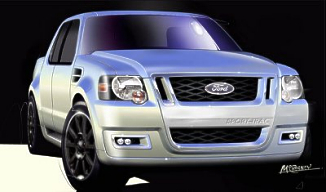
Explorer Sport Trac concept signals Ford's plans for the next generation of the original sport utility truck - longer, wider and more versatile than today's Sport Trac.
-
All-new independent rear suspension delivers an improved ride.
-
Explorer Sport Trac concept showcases Ford's exclusive Roll Stability Control™, which adds another dimension of sensing to conventional electronic stability control systems.
-
Featuring a lowered front and rear with massive 21-inch wheels, Explorer Sport Trac concept showcases street rod looks that could appear on a special-edition production vehicle.
|
DEARBORN, Mich. - The Ford Explorer Sport Trac concept delivers more of everything that helped the original sport utility truck launch one of the fastest growing segments in the industry. With a wider and longer stance and improved power, this concept offers even more versatility and flexibility than today's Explorer Sport Trac. It also comes equipped with Ford's exclusive Roll Stability Control™ - the only roll-motion and roll-rate sensing technology available on the market today. |
|
Ford invented the sport utility truck in 2001, bringing to market the Explorer Sport Trac - the first sport utility vehicle with the versatility of four full doors, a roomy feature-filled interior and a pickup truck's cargo box.
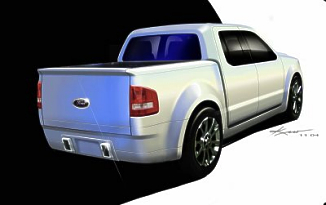
Versatility is central to Explorer Sport Trac's sales success. Today's Explorer Sport Trac is the only vehicle in its segment to offer a durable color-coordinated cargo box and an available swing-over tubular bed extender that dramatically increases its capability to haul oversized cargo. The Explorer Sport Trac concept's interior is larger and the cargo bed is about 30 percent bigger than today's model for increased cargo capacity.
The Explorer Sport Trac concept takes the vehicle to a new level - lower than ever for a mean, street look. Riding on massive 21-inch, 10-spoke aluminum wheels with a gunmetal finish and custom Goodyear tires, the Explorer Sport Trac concept delivers an improved ride thanks to a new independent rear suspension.
Exterior: Street Rod Style
The Explorer Sport Trac concept's smooth appearance is achieved by simple lines, excellent proportions and clean body panels. The exterior color is off-white Moonlight with a theme of polished aluminum accents found on the upper and lower grille, fog lamps and exhaust tips. The door handles have been shaved off, adding to the sleek look of this street rod machine. To get in, you simply press unlock on the key fob and the doors automatically open.
The Explorer Sport Trac concept is nearly 5 inches longer, 2 inches wider, and sits 2 inches lower than today's current Sport Trac model. Two side scoops located just in front of the A-pillar and two hood scoops give this concept a performance look. In the rear, sleek wraparound taillamps make a distinctive statement.
Distinctive Interior
Photos: Ford
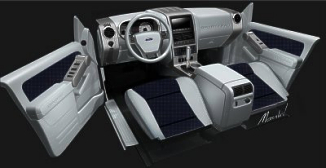
The Explorer Sport Trac concept's interior also is a tribute to the street rod look and feel. With two rows of seating, the environment is simple, yet modern. It features four bucket captain's chairs separated by a front and rear center console with an abundance of storage.
The interior color theme is two-tone - Light Ice blue and Midnight navy. The Light Ice leather seats have navy embossed mesh on the seat backs and inserts and are trimmed in contrast navy stitching. This color palette also is continued throughout the cabin accenting the steering wheel, front and rear center console, headliner, door trim panels, shifter and instrument panel.
The truck's primary gauges are contained within a singe oval instrument binnacle. The speedometer is prominently displayed next to the tachometer. Audio and climate controls are presented in the center of the instrument panel, just ahead of the floor-mounted shifter. Polished aluminum accents the air vents, instrument binnacle and shifter.
Built for Cruisin'
The Explorer Sport Trac concept is powered by a fuel-efficient, performance tuned 4.6-liter V-8 engine.
Independent rear suspension (IRS) delivers another performance enhancement on the Explorer Sport Trac concept - the first IRS application for the Sport Trac series. IRS offers significantly better handling over both smooth and rough surfaces. It absorbs bumps in the road and reduces impact harshness, resulting in improved ride quality.
Emphasis on Safety: Roll Stability Control™
The Sport Trac concept is equipped with Ford's exclusive Roll Stability Control™ technology, which adds another dimension of sensing to conventional electronic stability control systems. Roll Stability Control™ will be included on more than half a million Ford Motor Company SUVs by the end of 2005. Unlike any other system in the world, it features roll-rate sensing and correcting capability, offering assistance to the driver in maintaining vehicle control during extreme maneuvers. If the system detects the possibility of a rollover, within milliseconds, it automatically engages counter measures to help the driver maintain maximum control and further reduce the risk of rollover.
Ford's exclusive Roll Stability Control technology features a micro-machined gyroscopic sensor that determines the vehicle's body roll angle and roll rate. This information, along with Ford-developed algorithms embedded in advanced software, is used with other vehicle sensors' inertial information on yaw rate, lateral and longitudinal accelerations to monitor the vehicle's roll stability condition approximately 150 times per second.
(Dec. 2, 2004)
| .
Homepage News Companies Management Publications Events Guestbook Search . |