

.
.November
26, 2003
.
This Week:
-
X-TRAIL FCV is Latest in Nissan's Alternative Fuel Cell Technology
-
Volkswagen has made new top management appointments at German and international locations
-
Ford Invests $325 Million In Michigan And Ohio Plants To Build An All-New 6-Speed Transmission
© 1998
- 2003 Copyright &
Disclaimer
Automotive Intelligence,
www.autointell.com
All Rights Reserved .
For questions please contact
editor@autointell.com
.
X-TRAIL FCV is Latest in Nissan's Alternative Fuel Cell Technology
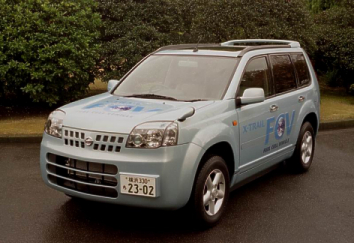
Photo: Nissan
|
Tokyo - Nissan's dedication to real environmental improvement is deeply connected to its clean technologies such as fuel cell vehicles (FCVs). Fuel cells hold the promise of high efficiency while creating zero emissions, making them the potential clean power source of the future. Approved by the Japanese Minister of Land, Infrastructure and Transport in November 2002, Nissan's high-efficiency X-TRAIL FCV has already proven itself in extensive public road testing in Japan. Improvements were made to the X-TRAIL FCV on the basis of those tests, and limited lease of this FCV began in 2003, two years ahead of the original schedule. |
|
Creative technology to create a better life for everyone
Nissan is actively engaged in the development of hybrid vehicles and fuel cell vehicles. Independently, innovative technologies have been developed for achieving compact, highly efficient motors and batteries that will play key roles in future powertrain systems.
The Nissan X-TRAIL FCV is a high-pressured hydrogen-powered vehicle that delivers clean power, without noxious emissions. It employs elements of a variety of technologies, including electric vehicle (EV), hybrid electric vehicle (HEV), and compressed natural gas vehicle (CNGV) technology.
Nissan-Exclusive Super Motor
In an ordinary motor, a rotor fitted with permanent magnets rotates around electromagnets (stator) to generate power that is output through one shaft. The Super Motor incorporates a new technique of applying compound current to the electromagnets and has two rotors positioned both on the inside and outside of one stator, allowing power to be delivered through two shafts.
The innovative Super Motor can achieve dramatic improvements in compactness and efficiency compared with the use of two motors. Additionally, it controls the power of each shaft separately, making it possible to drive right and left independently, enhancing dynamic performance and stability. One motor package also incorporates the dual functions of a motor and a generator.
The Super Motor can be utilized in a wide variety of applications, including on fuel cell vehicles and hybrid vehicles, which benefit from the use of its generator function.
Compact Lithium-ion Battery
Nissan has been a pioneer in applying lithium-ion batteries to vehicles. As a result of long-term research, Nissan has succeeded in obtaining exceptionally high output characteristics and in developing a laminated lithium-ion cell in place of the conventional cylindrical shape. The use of a laminated cell as an automobile battery, which has a high current rate, requires larger terminals. The sealing performance of the cell also becomes an issue because of the gas produced by repeating charging and discharging cycles.
Nissan addressed these issues by developing a laminated cell for use on vehicles. The laminated cell design reduces the weight and volume by half, compared with the conventional cylindrical type. In addition, the thin cell construction improves cooling efficiency dramatically and also allows excellent vehicle mountability, making it possible to achieve a low, flat floor. These and other advantages lead to compact, highly efficient vehicle packaging when the laminated cell is applied to hybrid vehicles and fuel cell vehicles.
Overview of X-TRAIL FCV
The Nissan X-TRAIL FCV is a high-efficiency hybrid fuel cell vehicle. It is equipped with a compact, high-performance lithium-ion battery pack that is already being used on the Nissan Hypermini electric vehicle and other alternative fuel vehicles.
Future Technologies: A base in real-world needs
Nissan's approach to technological development is that it must be useful, affordable, pragmatic and easy-to-use. One good example is the e-4WD system, an outgrowth of Nissan hybrid car research applied in the March and Cube. The e-4WD is a compact, lightweight four-wheel drive system. Sensors perceive the amount of slip in the front wheels, applying electricity as needed to an electric motor driving the rear wheels. It provides the increased fuel economy of on-demand 4WD and eliminates the heavy propeller shaft and transfer case normally needed to supply power to the rear wheels.
X-TRAIL FCV at EVS-20
The Nissan X-TRAIL FCV will be at the 20th International Electric Vehicle Symposium and Exposition in Long Beach November 15-19.
(Nov. 14, 2003)
| .
Homepage News Companies Management Publications Events Careers Services Discussion Guestbook Search . |