|
|
 |
 |
||||||||
|
Automotive Intelligence - the web for automotive professionals and car enthusiasts |
|||||||||
|
Jun 2013
© 1998 - 2013
Copyright & |
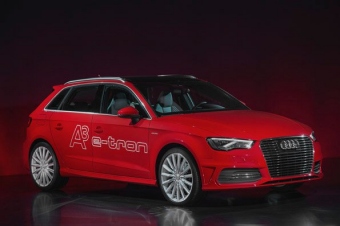
Motor sport is the ideal development lab for new technologies, and the toughest test environment is the 24 Hours of Le Mans. At last year’s competition on the Sarthe circuit, the R18 e-tron quattro brought Audi a historic double victory with a hybrid racecar that highlights just how much power an electrified driveline can put on the road. In terms of its concept, the LMP-1 prototype is an uncompromising racing car, but in numerous individual areas it harbors potential that could ultimately find its way into production models The V6 TDI in the 2012 Le Mans winner supplies over 375 kW (510 hp) and 850 Nm (626.93 lb-ft) to the rear wheels. The motor-alternator unit (MAU) on the front axle is always good for 150 kW of extra thrust when accelerating out of a bend. Here it uses energy that it has captured during braking operations and stored temporarily in a flywheel energy storage system. When both electric motors on the front axle are active, the LMP-1 prototype becomes a quattro. As well as the R18 e-tron quattro, last year Audi brought out a second high-tech car – the all-electric-drive R8 e-tron high-performance sports car. It sprints from a standstill to 100 km/h (62.14 mph) in 4.2 seconds and is governed at 200 km/h (124.27 mph). Its two electric motors supply the rear wheels with a combined 280 kW of power and 820 Nm of torque (604.80 lb-ft). With its body made from aluminum and carbon-fiber-reinforced plastic polymer (CFRP), the multimaterial space frame of the Audi R8 e-tron is the latest manifestation of the ultra lightweight construction technology of Audi. Every facet of this high-performance sports cars demonstrates the sheer breadth of what is technically feasible. All components are systematically configured for maximum performance and range. All Audi production developments will now benefit from the expertise acquired throughout this project. There is for instance the large T‑shaped battery that doubles up as a supporting element and stores almost 49 kWh of energy, enough to drive 215 km (133.59 miles). The heat pump controls the temperature of the interior and assemblies energy-efficiently. The aerodynamics have also been optimized for maximum efficiency. The engineers of Audi have covered all key aspects of electric mobility with the R8 e-tron. The Audi A1 e-tron is a technology demonstrator of entirely different stature. It is conceived as a specialist for urban driving. Its electric motor achieves peak output of 85 kW. The battery stores 13.3 kWh, making a operating range of 50 km (31.07 miles) possible. For longer journeys a rear-mounted combustion engine, which in its second development stage develops 25 kW (34 hp), charges up the electric motor via an alternator. Audi is participating in the German government’s “Electric Mobility Showcase” pilot project by running the A1 e-tron in six regions throughout the country in order to obtain more practical findings. The A3 Sportback g-tron and A3 Sportback e-tron already show how diverse the Audi range of technologies for sustainable mobility is. Audi will be bringing further pioneering cars onto the market in rapid succession. Photo: Audi (2013-05-27)
|
||||||||