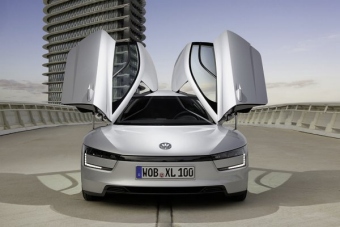
Volkswagen to produce XL1 by
handcrafting-like production methods at its Osnabrück plant in Germany
XL1 is the most aerodynamic production car
ever
0.9 litre combined fuel consumption was a
vision – now it is a reality
Wolfsburg - The XL1 from Volkswagen is the
most fuel-efficient production car in the world, with a fuel consumption
value of 0.9 l/100 km. Thanks to its plug-in hybrid system, the
two-seater can also cover a distance of up to 50 km in all-electric mode
and therefore with zero local emissions.
The XL1 is an automotive hero that follows
pure sports car design principles: low weight (795 kg), perfect
aerodynamics (Cd 0.189) and a low centre of gravity (1,153 mm high).
This gives the efficient Volkswagen the ability to cruise on the road at
a constant speed of 100 km/h using just 6.2 kW / 8.4 PS. In all-electric
mode, the XL1 requires less than 0.1 kWh to cover a driving distance of
over one kilometer.
High-tech lightweight design, perfect
aerodynamics and a plug-in hybrid system – consisting of a two-cylinder
TDI engine (35 kW / 48 PS), E-motor (20 kW / 27 PS), 7-speed dual clutch
gearbox (DSG) and lithium-ion battery – all make it possible for the new
Volkswagen XL1 to emit just 21 g/km of CO2. If necessary, the XL1, with
a top speed of 160 km/h, can accelerate to 100 km/h in just 12,7
seconds. Clearly, 0.9 l/100 km fuel consumption is a record figure that
has not been achieved by any other vehicle to date, and it illustrates
how Volkswagen is redefining what is technically feasible in carmaking.
Conceptually, the XL1 represents the third
evolutionary stage of Volkswagen’s 1-litre car strategy. When the new
millennium was ushered in, Prof. Dr. Ferdinand Piëch, who is today
Chairman of the Supervisory Board of Volkswagen AG, formulated the
visionary goal of bringing to market a production car that was practical
in everyday use with fuel consumption of one litre per 100 km. In the
two-seat XL1, this vision has become reality. Despite the tremendous
efficiency of the XL1, developers successfully came up with a body
concept, which delivers more everyday utility than in the two previous
prototypes. While the driver and passenger sat in a tandem arrangement
for optimal aerodynamics in the L1, the 1-litre car presented in 2002
and in 2009, in the XL1 two occupants sit slightly offset, side by side,
nearly as in a conventional vehicle.
The XL1 is 3,888 mm long, 1,665 mm wide
and just 1,153 mm tall. By usual automotive standards these are extreme
dimensions. For comparison: a Polo has a similar length (3,970 mm) and
width (1,682 mm) but is significantly taller (1,462 mm). Even a purebred
sports car like today’s Porsche Boxster is 129 mm taller (1,282 mm). So,
the XL1 will make a spectacular appearance – a car of the future, built
for today.