BMW Head-Up Display: A decisive
contribution towards driving safety
Munich - Low-flying over hilly terrain at
a speed of almost 800 kilometres per hour in the cockpit of a
Eurofighter jet is a challenge to even the most hardened of military
pilots. “When you’re flying at tree-top height at around 220 metres a
second, only extremely accurate head-up display technology is able to
provide the necessary ease of mind,” comments Wing Commander Robert
Hierl, test pilot at the Technical and Airworthiness Centre for
Aircraft.
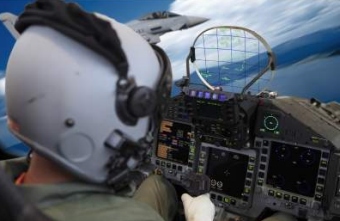
By means of a front panel projector, all
flight-relevant data supplied by the flight management system as well as
information and signals crucial to a mission are displayed on a second,
vertically positioned panel located in the cockpit. In order to prevent
the pilot from being distracted, all information is displayed in virtual
form at eye level within the direct field of vision, thus guaranteeing
the highest degree of concentration, supremacy and safety for both the
pilot and the machine.
BMW was the first European car builder to
adapt head-up display technology – a system initially deployed in
aviation and constantly further developed over several decades – for use
in volume-production vehicles. Since January 2004, this innovative
driver assistance system has been an integral part of BMW ConnectedDrive
offered for the BMW 5 Series. Consistently further developed and
optimised, it is now a full-colour head-up display and optionally
available for almost all series.
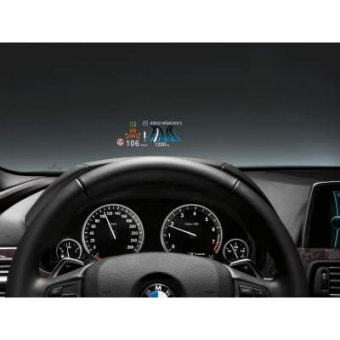
In terms of graphic representation,
functionality and flexibility, the unique new Head-Up Display feature
makes a significant contribution towards active safety by displaying
driver-relevant information in high-quality resolution within the
driver’s direct field of vision, so that he or she does not have to take
their eyes off the road. A crucial gain in safety as researchers know: A
normal driver takes a whole second to read the speed indicator in the
instrument panel or to glance at the navigation device. Whilst the
driver is distracted, that is without his or her eyes on the road, the
vehicle covers a distance of around 14 metres when travelling in urban
areas at a speed of 50 km/h – virtually a “blind flight”.
With Head-Up Display, the time required by
the driver to assimilate information is reduced by more than a half, the
system making a decisive contribution towards concentrated and focused
driving. The virtual image projected onto the windscreen is perceived as
“hovering“ at eye level above the bonnet and is visible only to the
driver. Moreover, this form of display is less tiring, as the eye does
not have to constantly change between close-range and remote vision.
Also, the brightness of the image adjusts perfectly to the surroundings,
so that the eye does not have to readapt each time.
The reproduction of data is effected by
means of an intense light source, which is located inside the instrument
panel and shines through a translucent TFT (Thin Film Transistor)
display, the image being transferred to the windscreen via specially
shaped mirrors. Owing to the convex shape and the physical properties of
glass, using the windscreen as a reflector is an extremely complex
process. In a windscreen, the light path is normally refracted,
resulting in double images.
In the case of the Eurofighter, this
problem is solved by means of an additional panel located directly
within the pilot’s field of vision. BMW tackles this physical phenomenon
with the aid of a wafer-thin foil, which is integrated into the
windscreen, ensuring the superimposition of the projected images and, as
a result, flawless, undistorted representation. Full-colour Head-Up
Display offers the driver a tremendous increase in reading comfort. The
complete colour spectrum facilitates a realistic and thus more intuitive
display of images and symbols. These speak for themselves, are perceived
even faster and do not have to be decoded or interpreted. Even
Eurofighter test pilot Robert Hierl is highly impressed: “Our monochrome
head-up display technology is unable to offer such a brilliant display
quality.”