|
Infrastructure in the USA:
California points the way forward
The F-CELL World Drive is particularly highlighting the still
existing gaps of the global hydrogen infrastructure. By the end
of the USA section of the tour on 18 March, the B-Class F-CELL
vehicles will have been refuelled around 35 times on the route
from Miami to Seattle – but only one of these refuelling
procedures will have taken place at a public hydrogen filling
station, located in the Greater Los Angeles Area.
"The American market is already
active in the field of fuel cell technology, but like in Europe,
there is still a need for development when it comes to
infrastructure. Together with our regional partners, we want to
point out the potentials of this technology and to get important
lead markets ready for the rollout of a high number of electric
vehicles with fuel cell technology," says Dr. Thomas Weber, the
Daimler AG Board Member responsible for Group Research and
Development for Mercedes-Benz Cars. So far there are a few
filling stations in California as well as on the East Coast of
the USA, in the city of New York and also in Michigan. Most of
the activities are currently taking place in California,
however. Customers in the city of Los Angeles – where a number
of Mercedes-Benz B-Class F-CELL vehicles have been on the road
since the end of 2010 – can already refuel their vehicles at
five public hydrogen filling stations. Of these, three are
equipped with the latest – and meanwhile globally standardized –
700-bar technology which enables the tanks of B-Class vehicles
to be filled in just three minutes for a range of about 400
kilometers.
Alongside further deliveries of
B-Class vehicles with fuel cell drives to customers in the USA
in 2011 and 2012, it is concretely planned to extend the supply
network in American metropolitan areas. During a second stage
they will then be linked up to each other. These steps will
consequently spread fuel cell technology.
According to a study by UC Davis
[1] , the basic supply of such zero-emission vehicles could be
guaranteed with only about 40 hydrogen filling stations in the
metropolitan area of Los Angeles. The State of California
already provided an initial funding. Until today, 27 million
US-Dollars went into the promotion of a hydrogen infrastructure.
Another 14 million US Dollars is expected to be invested in
2011. For 2011 and 2012, the opening of further filling stations
has been announced, four in the greater area of Los Angeles, two
stations in the San Francisco Bay Area and 10 more stations in
2012. From 2012, a total of about 20 stations in California will
supply electric vehicles with fuel cell technology with the
necessary hydrogen.
These positive developments in the
hydrogen infrastructure of California are also the result of
Daimler AG's almost 20-year commitment to fuel cell technology.
For many years the company has been an active member of the
California Fuel Cell Partnership (CaFCP), an amalgamation of
automotive manufacturers, energy suppliers, government bodies
and technology companies, and also the newly established Fuel
Cell and Hydrogen Energy Association (FCHEA) in California.
The production of the necessary
hydrogen today already provides a firm foundation for a future
hydrogen infrastructure. The hydrogen industry in the USA could
already supply up to 40 million vehicles. Pipelines, which can
transport the hydrogen from the producers to the end-users, are
already in place in many parts of the country.
A need for action in Europe
Prior to the US stage, the World
Drive already clocked up more than 3600 kilometers in Europe,
where the filling station network is also under development.
Generally speaking, there is also capacity for hydrogen
production. The long-term goal is to produce regenerative
hydrogen, for example by means of wind, water or solar energy,
geothermics or biomass, so that the entire energy chain, from
production through to consumption by the vehicle, is
emission-free or in other words CO2 neutral.
"The potentials of e-mobility with
fuel cell technology are huge. If not now, when else is there a
chance to establish Europe as the leading market for this future
technology? Other nations are already on their way," Thomas
Weber reviews the current situation. For the ambitious goals of
the European Union and the G8 countries include to cut overall
CO2 emissions by 80 percent by the year 2050. Efforts are
therefore being made in the transport sector to reduce CO2
output by 95 percent. Against this background, the use of
electric vehicles using fuel cells and batteries is essential in
order to make a significant contribution to long-term,
sustainable mobility.
A recently published study
investigating the potential of electrified drive systems in
Europe came to the same conclusion [2] . Electric vehicles with
fuel cell technology are also suitable for long journeys, which
are usually made with medium-size and larger vehicles. These
make up some 50 percent of total passenger car numbers and are
also responsible for 75 percent of CO2 passenger car emissions.
The fuel cell drive therefore represents an effective solution
for the reduction of CO2-emissions in road traffic and has
tremendous potential for mass production (1 million vehicles
across Europe in 2020, or 25 percent of the market in 2050).
H2 Mobility – commitment to
sustainable infrastructure measures in Germany
Daimler is active in a variety of
different initiatives in order to drive forward the
commercialisation of electric vehicles as well as the necessary
infrastructure measures. Daimler AG has therefore launched an
initiative together with Linde AG, for example, with the aim of
developing a national hydrogen filling station infrastructure.
In 2009 this resulted in the H2 Mobility initiative, through
which major energy suppliers, corporations in the mineral oil
industry and also other additional partners have come to an
agreement on setting up a comprehensive hydrogen infrastructure
in Germany. This is because a necessary prerequisite for the
commercialisation of fuel cell vehicles is a corresponding
hydrogen filling station network. Initial centres are in the
process of development in large conurbations, such as Berlin and
Hamburg. "We have invested successfully and to a large extend in
the maturity of fuel cell technology in vehicle application. Now
the infrastructure needs to be developed. We are convinced that
these investments are not only worthwhile, but that there is no
alternative for the sustainability of a demand meeting,
individual mobility," explains Thomas Weber.
Mercedes-Benz F-CELL World Drive
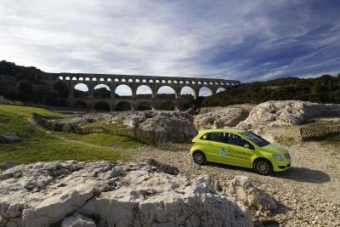
During the F-CELL World Drive,
three Mercedes-Benz B-Class F-CELL vehicles are passing through
14 countries and 4 continents - to drive around the globe once.
Organised by Mercedes-Benz, the circumnavigation of the world
started on 30 January 2011 in Stuttgart and is scheduled to last
125 days, until the vehicles return to Stuttgart again at the
beginning of June, after covering a distance of some 30,000
kilometres. The aim of the tour is to demonstrate the technical
maturity and suitability for everyday use of electric vehicles
with fuel cells, and at the same time highlight the need for the
development of a comprehensive hydrogen infrastructure.
Mercedes-Benz is being supported on the tour by Linde AG, which
is responsible for supplying the hydrogen.
Photo: M-B
(Mar 15, 2011)
|