|
Four powerful and fuel-efficient
four-cylinder engines
1.4 TSI with 122 PS: In Europe,
the Eos is powered as standard by a 90 kW / 122 PS 1.4-litre TSI
engine (max. torque 200 Newton metres from 1,500 rpm). This
turbocharged direct injection petrol engine allows a top speed
of 198 km/h. Combined fuel consumption: 6.6 l/100 km (equivalent
to 152 g/km CO2). In this engine configuration the Eos can also
be ordered with BlueMotion Technology. Consumption is then
reduced to 6.2 l/100 km (144 g/km CO2).
1.4 TSI with 160 PS: For the next
level of engine power Volkswagen uses a 1.4-litre TSI with
twincharger (turbo and compressor). It delivers 118 kW / 160 PS.
The top speed of the Eos 1.4-litre TSI with this power output is
217 km/h. The high-torque twincharger (240 Newton metres from
1,500 rpm) enables comfortable cruising at low revs. Combined
fuel consumption: 6.8 l/100 km (157 g/km CO2).
2.0 TSI with 200 PS and 210 PS:
The most powerful petrol engine available for the new Eos is the
2.0-litre TSI. In the USA it produces 147 kW / 200 PS, while in
Europe it will deliver 155 kW / 210 PS. The European version of
this turbocharged direct injection engine develops a maximum
torque of 280 Newton-metres from 1,700 rpm. Top speed: 238 km/h.
Combined fuel consumption: 7.1 litres (165 g/km CO2). In Europe,
Volkswagen will offer the dual clutch gearbox (DSG) on the Eos
2.0-litre TSI as an option. The DSG version achieves a top speed
of 236 km/h and consumes 7.5 litres of fuel per 100 kilometres
(174 g/km CO2). The 2.0-litre TSI of the American Eos - with
standard DSG - develops an identical maximum torque of 280
Newton metres or 207 foot pounds from 1,800 rpm. In the US
Highway cycle, the Eos 2.0 TSI attains a fuel economy of 31* mpg
(City: 22* mpg).
2.0 TDI with 140 PS: The Eos
2.0-litre TDI (103 kW / 140 PS) is extremely fuel-efficient. At
5.2 l/100 km (138 g/km CO2), the four-cylinder engine,
delivering 320 Newton-metres of torque, consumes 0.3 litres less
fuel than the previous model. This engine can also be ordered
with BlueMotion Technology (BMT) modifications. In this case,
fuel consumption is reduced to 4.8 l/100 km (125 g/km CO2),
which represents a 0.7 litre improvement compared to the
previous model. Both versions reach a top speed of 207 km/h. The
2.0-litre TDI and 2.0-litre TDI BMT are also both available with
a six-speed DSG transmission. The standard version then consumes
5.7 l/100 km (149 g/km CO2) and the BlueMotion Technology model
5.3 l/100 km (139 g/km CO2). These fuel consumption figures make
the new Eos one of the most fuel-efficient cabriolets in the
world.
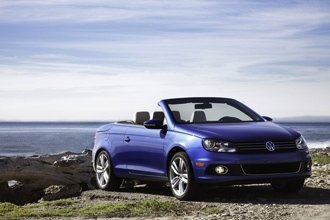
Photo: VW
(Nov 20, 2010)
|