

Automotive Intelligence - the web for automotive professionals and car enthusiasts
February 06, 2008
This Week:
-
The new Audi RS 6 Avant brings winning motor sport technologies to the road
-
Scion Announces Pricing For tC Release Series 4.0 To Be Displayed At The 2008 Chicago Auto Show
© 1998 - 2008
Copyright &
Disclaimer
Automotive Intelligence,
www.autointell.com
All Rights Reserved .
For questions please contact
editor@autointell.net
|
Intelligent dynamism - the new-generation Mercedes-Benz SLK
Stuttgart - The Mercedes-Benz SLK-Class Roadsters have long captured the hearts of sports car enthusiasts. Following an extensive facelift incorporating around 650 newly developed components, the SLK models of 2008 are even more dynamic and now offer an even more emotionally charged driving experience. Key visual enhancements include new-look front and rear sections, as well as a meticulously modified interior with a new instrument cluster and three-spoke sports steering wheel. The high-revving V6 sports engine in the SLK 350 developing 224 kW/305 hp and an optionally available direct-steer system truly bring the bold, dynamic character of the two-seater to the fore. Furthermore, all of the engines in the line-up are now far more economical on fuel and therefore emit even less CO2, despite a substantial increase in output in some cases. The new-generation SLK models will be available for delivery from April 2008. |
|

|
|
|
Since their first appearance in 1996, the compact SLK Roadsters have come to symbolise Mercedes-Benz' dynamic brand image. Already a familiar sight on our roads, the second-generation two-seater is to be further enhanced with the implementation of a raft of measures in 2008, the aim being to further emphasise the car's sporty character and continue the SLK-Class success story by introducing new dynamic and powerful elements. Some 310,000 first-generation roadster models were sold between 1996 and 2004. And around 185,000 customers - some 60,000 of them in Germany alone - have already purchased the second-generation model since its launch in March 2004 (figures at year-end 2007). This means that total unit sales of the SLK Roadster are now approaching the half-million mark. The second-generation SLK has therefore retained the car's quite unique status in this market segment.
The new-generation SLK blazes a trail of new sporty highlights, bestowing yet greater appeal on this thriving two-seater with the trendsetting vario-roof that transforms the car from a roadster into a weatherproof coupé in a matter of seconds.
Distinctive character: even more pronounced V-shape at the front and a diffuser-style rear
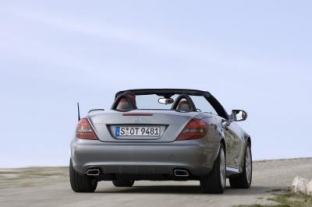
The designers have honed the looks of the cult two-seater for added sportiness. Eye-catching features include the new-look front bumper with a modified air-dam arrangement and a more pronounced V-shape, while the area around the Mercedes star now stands out more boldly. The designers have also remodelled the vehicle's tail, with the diffuser-look styling at the bottom giving the Roadster an even more powerful appearance from the rear too. This is further emphasised by the trapezoidal exhaust tailpipes and the AMG-inspired darkened tail lights. The now larger exterior mirrors feature LED indicators with a pronounced arrow shape, while the range of light-alloy wheels is also almost entirely new.
High-quality cockpit and new three-spoke sports steering wheel
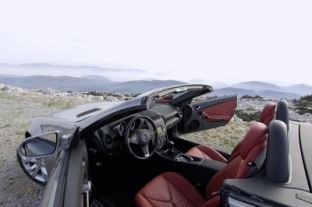
Many of the interior's details have undergone remodeling too, and the interior has been refined as a whole by meticulous material selection. Particular care was taken to optimise the interior in such a way as to make it that much more driver-focused again. Centrepieces include a new three-spoke sports steering wheel with multifunction buttons as well as a new instrument cluster with intriguing-looking dial bezels.
High-revving sports engine: added power and considerably lower consumption
Making a mighty contribution to the sporty billing of the 2008 generation of the SLK are three reengineered drive units, which all make their mark with lower fuel consumption, resulting in reduced CO2 emissions. Both the four-cylinder engine in the SLK 200 KOMPRESSOR and the six-cylinder sports engine in the SLK 350 benefit from a substantial increase in output and torque. Only the SLK 55 AMG retains its familiar engine - an eight-cylinder unit that has lost none of its mesmerising performance capability and remains a unique selling point in the SLK segment.
The Mercedes-Benz engineers devoted particular attention to the V6 sports engine with high-revving concept, which is making its debut in the new-generation SLK. By performing a major overhaul of the engine's mechanics, the engineers succeeded in giving the V6 unit a completely new lease of life. Although the displacement remains the same at 3498 cc, the engine now musters up 224 kW/305 hp at 6500 rpm - some 24 kW (33 hp) more than its predecessor. Torque has been upped too (+ 10 Nm) and now peaks at 360 Nm at 4900 rpm.
Yet despite its higher power output and such high-calibre performance, fuel consumption in the SLK 350 has been cut by a sizeable margin. With the six-speed manual transmission on board, combined fuel consumption is just 9.5 litres per 100 km, a remarkable reduction of 1.1 litres per 100 km; if the 7G-TRONIC automatic transmission is fitted, the sports engine limits itself to a mere 9.2 litres for every 100 km on the combined cycle - 0.9 litres less than previously. The cut in fuel consumption also lowers CO2 emissions by 23 g/km to 219 g/km on the automatic model (manual transmission: 227 g/km, a reduction of 28 g/km). Visually enhanced SLK 55 AMG
On a technical level, the SLK 55 AMG remains almost unchanged. The only differences are a few visual enhancements. The front end of the AMG model now features a new apron with a black-painted transverse fin and side air outlets, as well as darkened headlamps.
The trendsetting SLK
As trendsetters and technology leaders, the SLK-Class Roadsters have long enjoyed the image of a modern cult car. Even after the extensive modifications, the familiar outstanding qualities remain; for example, the vario-roof that transforms the Roadster into a coupé in 22 seconds, not to mention the comprehensive standard specification, including head/thorax sidebags, adaptive front airbags and two-stage belt-force limiters. Plus, the Roadster also comes with the option of the unique AIRSCARF neck-level heating system, which allows open-top driving pleasure all year round, even in the winter months.
Photos: Mercedes
(Jan 31, 2008)
| .
Homepage News Companies Management Publications Events Guestbook Search . |