

Automotive Intelligence - the web for automotive professionals and car enthusiasts
July 18, 2007
This Week:
-
Porsche will present new 530 Horsepower 911 GT2 at the Frankfurt Auto Show
-
Mercedes takes the roof off its top sports model creating the SLR McLaren Roadster
-
Classic Ferraris compete in the Historic Challenge at Le Mans
-
New Beetle Owners from all over Europe parade at the Sunshine Tour along German Baltic Coast
-
MCM Director Micheal Michalsky hosts after-show party at Friedrichstrasse in Berlin,
-
Four GM vehicles became movie stars in "Transformers" and will save the earth
-
Munich, Germany, witnesses the new Maserati GranTurismo at the Hotel Bayerischer Hof
-
A long story finally ends: BMW Group transfers shares in Tritec to DaimlerChrysler
-
Ford committed to invest €675 Mill. in Craiova Plant in Romania in case of winning the bid
-
GM Plans Investment of 50 Percent in Equity Interest in VM Motori
-
DaimlerChrysler Engine Plant in Bad Cannstatt, Germany, celebrates tenth Anniversary
© 1998 - 2007
Copyright &
Disclaimer
Automotive Intelligence,
www.autointell.com
All Rights Reserved .
For questions please contact
editor@autointell.net
|
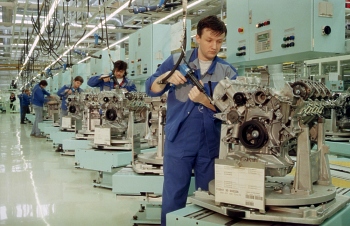
DaimlerChrysler Engine Plant in Bad Cannstatt, Germany, celebrates tenth Anniversary The Bad Cannstatt plant was inaugurated in April 1997, following a mere 18 months of construction, in the presence of Erwin Teufel, then Premier of Baden-Württemberg. It was erected on the site of a former rail freight station at an investment of DM 700 Million (€350 million) and has produced V6 and V8 gasoline engines ever since. A crucial factor in favor of the Bad Cannstatt location was the existence of an optimal framework.
This included not only the 1993 agreement between plant management and the works council on flexible working hours and teamwork with clearly defined targets, all of which represented major prerequisites for efficient manufacturing.
|
|

|
|
In addition, the creation of a modular system made it possible to manufacture, for the first time anywhere in the world, V6 and V8 engines in a joint production operation. At the same time of the new V-engine plant in Bad Cannstatt, new production lines were also set up in Untertürkheim, as part of a complete restructuring, for the production of inline engines and engines for the A-Class. |
2001 work began to expand the engine plant. A new building, constructed with an investment of around €25 million, was added to the existing facility, thus enlarging the total production area by around 18,000 square meters - roughly the equivalent of two soccer fields - and extending the total length of the plant to almost one kilometer. With the production launch of the new generation of V6 /V8 gasoline engines in 2004/2005, the plant's output increased from 1,750 to 2,600 units a day. Today, some 1,200 employees work at the Bad Cannstatt plant, which last year produced around 400,000 V6 and V8 engines. All in all, more than three million engines have rolled off the production lines in Bad Cannstatt since 1997.

Despite the use of sophisticated manufacturing and automation technology, the concern for the success of the workforce remains paramount in Bad Cannstatt. This is reflected in the plant architecture, which attaches great importance to openness, transparency, and integrated zones for teamwork and communication. All the teamwork is project-based and cross-hierarchical. Likewise, all employees are fully involved in ensuring that projects run smoothly, setting targets, and optimizing the various processes, all of which demands an entrepreneurial mentality and conduct. To this end, employees and the plant management have agreed on a set of values from the very beginning - values based on criteria such as trust, respect, and responsibility.
The plant was designed in a way to combine profitable production with environmental responsibility right from the start. Here, efficient use of all resources means that energy consumption can be cut to an absolute minimum. Such a philosophy goes hand in hand with minimizing waste, using a closed system for process fluids as well as recycling metal swarf and shavings from mechanical processing. Indeed, with its closed process cycles, the Bad Cannstatt plant produces almost no waste or wastewater whatsoever, and its clean gas values fall well below the legal limits.
In combination with an ultramodern photovoltaic system, the plant's recovery and use of waste heat has likewise set new standards. The solar cells cover a total area of 5,000 square meters - one of the world's largest systems in its day - and generate 350,000 kilowatt-hours of power a year, enough to cover the electricity needs of over 120 households.
Moreover, beyond the gates of the plant there is now a veritable ecological paradise. Devised in cooperation with environmental and nature conservation organizations, the "Neckar River Gravel Bank Project" has resulted in the recreation of a riverside meadow some 4,000 square meters in area, featuring characteristic islands of warmth and a microclimate in which 40 different species of wild bee have already been recorded.
This holistic ecological approach has received praise from the Ministry of the Environment, which presented the Bad Cannstatt plant with the "Environmental Award for Industry" in 2004. The facility has also achieved a top position in the competition for the "Best Factory" award, which is to be presented in September of this year. These awards are proof that profitable production and environmental responsibility can indeed be brought into balance.
July 16, 2007
Photos: Mercedes-Benz
| .
Homepage News Companies Management Publications Events Guestbook Search . |