|
.
The BMW Arjeplog Test Base: BMW xDrive
All-Wheel-Drive System
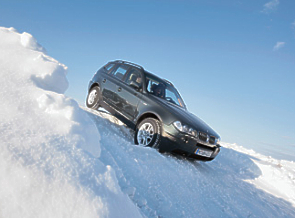
BMW
X3
To ensure consistent
and highly-concentrated development activities under optimum test
conditions, the BMW Group now has a new, Group-owned test base in
the town of Arjeplog in northern Sweden.
|
Just 56 kilometres
or 35 miles south of the Polar Circle, this new Test Centre
offers perfect climatic and logistic conditions for testing
vehicle components and new models in the process of reaching
production standards. The new facilities and buildings in
which BMW has invested some Euro 16 million serve to replace
several former test sites in a number of countries. Now,
therefore, all of the BMW Group's winter test activities
for the BMW, MINI, and Rolls-Royce brands may be conducted
at the new Central Base in Arjeplog, ensuring significant
synergies in work processes and even greater efficiency
than before.
|
|
Close cooperation of
engineers in numerous Divisions at the new Centre facilitates the
integration of work processes both in fundamental studies and practical
tests. This benefits in particular the development of networked
systems such as BMW's intelligent xDrive all-wheel-drive technology.
Operating in conjunction with DSC Dynamic Stability Control, xDrive
is particularly efficient in distributing drive forces not only
for optimum traction, but also for controlled and safe driving dynamics
in bends. And the extra driving pleasure ensured in this way also
in everyday use makes a significant contribution to the benefits
of this cutting-edge system and its great appeal.
Precisely this is why
BMW already offers no less than 21 models with xDrive - and current
developments indicate that soon more than every fourth BMW sold
worldwide will be equipped with this intelligent all-wheel drive.
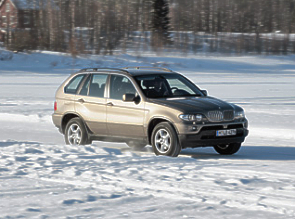
Photos: BMW
BMW
X5
Looking into the future,
BMW is going even further, focusing on ICM Integrated Chassis Management,
to use the project title, combining a wide range of drive and control
systems and integrating even more components in an all-round control
philosophy.
The new Test Centre
in northern Sweden offers optimum conditions for developing such
breakthrough technologies, allowing precise test and development
routines under consistent conditions for the drivetrain, suspension,
steering and brakes tested either individually or in their all-round
interaction. This is what the BMW Group defines as networked development
of fully integrated systems
Optimum working
conditions in the bitter cold:
Arjeplog has been the
preferred destination for winter testing for years, not only for
BMW, but also for many other car makers. Driving on frozen lakes
and snowbound roads is not only a gruelling test under extreme conditions,
but also a particular challenge for new drive systems.
With the new Test Centre
built exclusively for the requirements of the BMW Group, the German
manufacturer of premium cars is now highly autonomous at a location
ideally suited for this purpose: Investing some Euro 16 million
in Arjeplog, BMW has built an ultra-modern Test Centre offering
BMW engineers and mechanics optimum working conditions. Just one
example is the offices and workshops with generous dimensions and
facilities as well as ultra-modern technical amenities. A filling
station as well as a washing hall with various measuring and test
tracks is also part of the Centre, which, through its particular
location and climatic conditions, offers all the assets required
for optimum testing. Test routes are available from November until
April also on the frozen Kakel Lake directly next to the BMW Test
Centre, enabling BMW's specialists to conduct a wide range of driving
tests under the most demanding conditions.
Building the new Test
Centre, BMW naturally considered the specific requirements involved
in testing and maintenance of cars with hydrogen drive. And last
but not least, a secure network integrates the Arjeplog Test Centre
within the BMW Group's Research and Innovation Centre (FIZ) in Munich.
Previously tests were
conducted at rented facilities and in areas leased by the Company
for test purposes. Now, with a Company-owned Test Area, BMW benefits
from far greater flexibility in terms of both space and time management,
and has the opportunity to develop and test vehicles and components
with an even higher level of all-round integration. This mainly
involves vehicle components such as brake control systems, power
units and major modules, as well as overall vehicle testing procedures.
So engineers from all disciplines and areas of interest are now
able to work together closely in Arjeplog, finding optimum solutions
for new systems or entirely new models.
An important economic
factor in northern Sweden:
All buildings at the
Arjeplog Test Centre were constructed by Swedish companies in typical
local style on behalf of the BMW Group. In all, 11 jobs have been
created at the Centre, all going to employees from the region. From
November to March, an average of 100 BMW engineers and mechanics
work at the Test Centre, with up to 200 specialists employed on
the site in peak periods, usually going to Arjeplog for a period
of two weeks.
Test crews are accommodated
in housing offered by local service providers, who also serve food
and drinks. So for this reason alone, the Test Centre is an important
economic factor for Arjeplog and the entire Province of Norrbotten.
BMW has been conducting
a wide range of tests in Arjeplog, 56 kilometres or 35 miles south
of the Polar Circle, for many decades, helping to make this small
town the most important winter testing centre for the entire automotive
industry. Indeed, the advantages offered by the Arjeplog Region
may be summed up by three factors in particular: weather conditions,
geographical advantages, and low population density in the region.
Temperatures in northern
Sweden remain relatively constant between November and April at
an average of 10 °C below zero. And while the thermometer may drop
to 40 °C and even further below zero, precisely these relatively
consistent temperatures offer ideal conditions for reproducible
testing, with the many lakes in the area freezing over from October
until May. Properly prepared, the ice on the lakes will be up to
one metre thick, allowing not only passenger cars but even trucks
to drive on the lakes. Clearly, test circuits with various frictional
coefficients may be prepared on such icy surfaces and are then available
for constant use over a long period. A further important advantage
is that the noise inevitably caused by such testing procedures is
hardly a problem in this part of Sweden with the lowest level of
population density.
Even so, most tests
are conducted during the day, with tests at night being extremely
unusual. In other test regions such as the Alps, on the other hand,
many tests have to be conducted at night, since this is the only
time when temperatures remain sufficiently consistent over several
hours.
In the light of these
many advantages, numerous suppliers to the car industry also develop
and test their latest components and systems in Arjeplog, the presence
of nearly all system suppliers on the spot offering BMW's test team
even better conditions for integrating various systems, components
and technologies.
Networked systems
for even greater driving pleasure:
Integrated processes
are becoming increasingly significant above all in the ongoing development
of drivetrain technologies. This applies both to the systems as
such and to the way they are developed and tested. With the driving
behaviour of a modern car being determined by harmonious interaction
of engine output, power transmission, steering, stability control,
and the brake system, taking an integrated approach from the beginning
in the development phase is essential to ensure perfect harmony
of these and other modules and components. Indeed, some components
must not only be developed parallel to one another, but also "grow"
together to form one unit in a permanent process of development,
all features and qualities having to interact perfectly for optimum
dynamics and driving safety. Precisely the conditions required to
meet these needs are offered in Arjeplog, allowing BMW Group engineers
to provide an even higher standard of all-round driving pleasure.
BMW's intelligent xDrive
all-wheel-drive system is a fascinating example of numerous components
and technologies interacting as a perfect team: BMW's all-wheel-drive
system is masterminded via internal interfaces linking xDrive directly
to DSC Dynamic Stability Control. This ensures proactive improvement
of the car's driving behaviour quite unique throughout the entire
world of motoring. Using data also available to DSC, for example,
xDrive is able to detect any tendency of the car to over- or understeer
in a bend right from the start, building up and exerting appropriate
counter-forces.
Functions of this quality
and the unique variability of the system in distributing power to
the front and rear axles make BMW xDrive the most sophisticated
and advanced all-wheel-drive system in the market. Yet a further
advantage is that xDrive offers its benefits not only on winter
roads or off the beaten track, but rather under all conceivable
driving conditions, with the system having been developed specifically
to ensure active driving pleasure at all times.
All-wheel drive
becoming increasingly popular: BMW xDrive:
Never before has BMW
been able to offer customers as wide a range of all-wheel-drive
vehicles as in the 2006 model year: xDrive is available in no less
than four model series and 21 different models. BMW is therefore
in the lead also in this growing segment of the market, with BMW
xDrive offering its qualities in numerous different categories and
segments. The highly successful BMW X5 and BMW X3, for example,
dominate the market of attractive Sports Activity Vehicles (SAVs).
Looking at the BMW 5 Series, in turn, one out of every four cars
is now sold with all-wheel drive, and the new BMW 3 Series is for
the first time introducing this advanced all-wheel-drive technology
in the midrange segment, with BMW xDrive being available in both
the 3 Series Saloon and Touring.
The particular benefits
and fortes of the BMW xDrive all-wheel-drive system therefore offer
their advantages to the discerning customer in all of BMW's model
series. And these advantages come to bear not only when the car
suffers noticeable traction problems, since BMW xDrive is able to
determine the need for intervention in advance, virtually looking
ahead in preventing any loss of traction.
With qualities of this
kind, BMW xDrive clearly sets the benchmark in all-wheel-drive technology:
While conventional all-wheel-drive systems only respond when the
wheels are already spinning, xDrive is able to determine in advance
that the wheels are about to spin, feeding drive power from the
wheel concerned to the other wheels with better grip on the surface.
A further advantage
is that xDrive always distributes drive power the right way for
optimum driving qualities and transmission of power on the road,
sparing the driver of a BMW equipped with xDrive the disadvantages
of permanent all-wheel-drive systems with their fixed, inflexible
distribution of drive power: Under normal driving conditions 40
per cent of the engine's output goes to the front, 60 per cent to
the rear axle, thus maintaining the dynamic benefits and typical
feeling of rear-wheel drive. In everyday traffic, therefore, a BMW
with xDrive is just as agile and dynamic as a "regular" rear-wheel-drive
car.
|