|
|
 |
 |
||||||||
|
August 16, 2006 This Week:
Š 1998 - 2006
Copyright & |
In other words, PRE-SAFEŽ gives the car reflexes. When danger is detected, the new CL-Class responds as reflexively as a living being and activates the appropriate protective measures to avoid the risk of injuries or reduce their severity. This Mercedes invention is in line with the findings of accident researchers, which show that more than two-thirds of all serious accidents are preceded by critical driving manoeuvres that allow an impending collision to be predicted in advance. In the new CL-Class, PRE-SAFEŽ uses this advance accident detection phase, which can have a duration of several seconds in some cases, to:
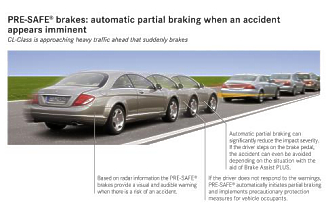
Automatic partial braking when a collision is imminent
The newly developed PRE-SAFEŽ brake system improves this preventative occupant protection even further. This unique system automatically brakes the CL-Class before an impending accident and operates in tandem with the Brake Assist PLUS (BAS PLUS) system introduced last year, which warns the driver of an imminent rear-end collision with visual and audible signals and automatically calculates the required braking pressure to prevent an accident. This braking-power support is available as soon as the brake pedal is operated. The PRE-SAFEŽ brake system goes one step further: if the driver does not react to the BAS PLUS warnings, the PRE-SAFEŽ brake system triggers automatic partial braking where an accident is imminent and slows the CL-Class down at a rate of up to 0.4 g (around 4 m/s˛), corresponding to around 40 per cent of the total braking power. In addition to the visual and acoustic warning, the automatic partial braking provides the driver with another clear warning to act. If the driver then immediately applies the brakes, the maximum braking force is available and the accident can - depending on the situation - be averted at the last moment. If an accident is unavoidable, the PRE-SAFEŽ brake system reduces the impact severity and, in turn, the risk of injury to the vehicle occupants. The anticipatory PRE-SAFEŽ measures on board the new Mercedes coupé are also activated automatically when the PRE-SAFEŽ brake system goes into action. As soon as the system commences automatic partial braking, the supporting bolsters in the dynamic multi-contour seats are inflated and the front passenger seat is moved to the most favourable position. As with Brake Assist PLUS, the new PRE-SAFEŽ brake system also utilises state-of-the-art radar technology to scan the situation in front of the car and detect a potential accident. Two short-range radar sensors with a range of 30 metres and a scanning angle of 80° are located behind the front bumper fascia on the CL-Class. The additional long-range radar in the radiator grille has a range of 150 metres. Accident severity reduced by 40 per cent Mercedes-Benz has conducted extensive tests on the effectiveness of the new PRE-SAFEŽ brake system. In the DaimlerChrysler Research driving simulator in Berlin, Mercedes engineers conducted a series of tests with 70 drivers who were deliberately distracted by an accident on the opposite carriageway during their journey, while the traffic ahead of them suddenly braked at the same time. The results of these tests demonstrate the increased safety made possible by the state-of-the-art support systems in the CL-Class: thanks to the rapid reaction of the drivers and the help of BAS PLUS with the PRE-SAFEŽ brakes, an accident was avoided during 70 per cent of these journeys. In one-third of these simulator tests the participants were unable to prevent an accident. In these cases the automatic partial braking function ensured a reduction of around 40 per cent in impact severity. Mercedes-Benz also offers the PRE-SAFEŽ brake system in conjunction with the optional DISTRONIC PLUS proximity cruise control and the BAS PLUS braking assistant. (Aug 14, 2006)
|
||||||||