

.
.October
20, 2004
.
This Week:
-
Jaguar Shows Significant Improvement In 2004 J.D. Power and Associates APEAL Study
-
MINI Cooper Most Appealing Compact Car For Third Year In A Row
-
Mercedes-Benz A-Class now equipped with new side airbags offering double protection
-
The first BMW Convertible with Diesel Power: The 320Cd Convertible
© 1998
- 2004 Copyright &
Disclaimer
Automotive Intelligence,
www.autointell.com
All Rights Reserved .
For questions please contact
editor@autointell.net
.
Mercedes-Benz A-Class now equipped with new side airbags offering double
protection
|
Stuttgart - The patented sandwich concept in the new Mercedes-Benz A-Class puts that vehicle ahead of the competition in the compact class when it comes to occupant safety. The unique design offers clear safety benefits not only in the event of a head-on collision but also when the car is impacted from the side. Protection of the head and chest in the latter situation is further enhanced by newly developed side airbags that come as standard equipment in the new A-Class. |
|
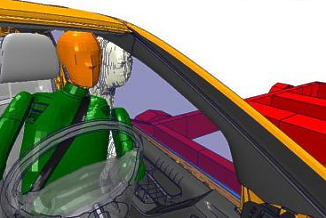
Thanks to the sandwich concept, passengers in the A-Class sit around 200 millimetres higher than in a conventional saloon, and are therefore better protected in a side impact crash than are occupants of other vehicles in this class. This is because the greater height ensures that the impact occurs where the A-Class is most stable: at the side rail, which consists of extremely rigid, solid sheet-steel profiles.
Photos: DC
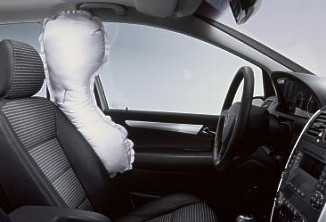
Standard side airbags are another new feature in the new A-Class. The sidebags in the predecessor model were installed in the interior door panels. In the event of a crash, they inflated at chest level between the occupant and the door, thus preventing any contact between the two. For the new A-Class, however, Mercedes engineers developed head/thorax side airbags that protect the chest and head, thus offering double the protection of the previously used sidebags.
The head/thorax side airbags are located in the front seat backrests. They inflate within milliseconds after a side impact to form an asymmetric buffer with a volume of approximately 16 litres. When inflated, their upper edge extends further upwards than the sidebags they replace.
As such, the head/thorax side airbag reduces the risk of the head impacting against the window or against objects penetrating into the vehicle's interior as a result of the crash. At the same time, the lower part of the new side airbag extends itself between the door and the occupant, creating a large-surface protective shield for the chest area.
Mercedes-Benz' installation of head/thorax side airbags as standard equipment in the new A-Class comes in response to studies showing that side impacts are becoming increasingly dangerous for passenger car occupants. In fact, some 44 percent of these types of collisions end with one or more fatalities.
(Oct 20, 2004)
| .
Homepage News Companies Management Publications Events Guestbook Search . |