

.
.October
13, 2004
.
This Week:
-
Ford's F-Series Truck Sets Month And Year-To-Date Records With September Sales Of 99,720
-
Three Honda Vehicles Earn Highest Rating in EPA's 2005 Fuel Economy Guide
-
GM Showcases Hydrogen and Hybrid Technologies at China's Initial Michelin Challenge Bibendum
© 1998
- 2004 Copyright &
Disclaimer
Automotive Intelligence,
www.autointell.com
All Rights Reserved .
For questions please contact
editor@autointell.net
.
GM Showcases Hydrogen and Hybrid Technologies at China's Initial Michelin
Challenge Bibendum
-
Announces first hybrid project with SAIC
-
Demonstrates near, mid- and long-term solutions
|
|
|
Shanghai - General Motors China today announced the first joint hybrid bus program with Shanghai Automotive Industry Corporation Group (SAIC) for the China market in conjunction with its participation in the Michelin Challenge Bibendum.
The world's largest automaker is showcasing a range of near, mid- and long-term solutions for cleaner, sustainable transportation at the world's premier clean vehicle event, which is being held in Shanghai from October 12-14.
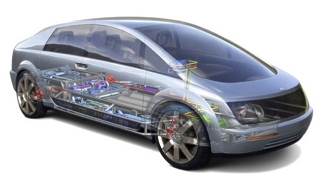
GM's broad range of advanced automotive technologies on display, which dramatically reduce emissions and improve efficiency, include the revolutionary Hy-wire and HydroGen3 hydrogen-powered fuel cell vehicles, and a parallel hybrid pickup.
The joint hybrid bus program will utilize a hybrid powertrain developed by GM's Allison Transmission Division that uses dual electric motors to launch the bus from a stop and regenerative braking to capture energy in an advanced battery system. It will be packaged in a bus manufactured by Sunwin, SAIC's bus joint venture in Shanghai.
The hybrid technology is already being used to power public buses in several American cities including Seattle, Philadelphia, Minneapolis and Portland. It has demonstrated the capability to yield as much as 60 percent better fuel economy and reduce certain emissions by up to 90 percent. Because of the unique configuration of its hybrid electric drive, the bus will generate less noise, require less brake maintenance and produce less engine wear.
GM and SAIC will jointly produce one hybrid bus for commercial evaluation in the primary stage of the program. The partners will then leverage real-world in-use data to study the feasibility of mass-producing the hybrid bus for Shanghai and China.
There are currently about 17,000 buses in operation in Shanghai. Each runs an average of 155 miles (250 kilometers) per day. A 30 percent improvement in fuel economy could result in savings of 12 tons of fuel per vehicle per year.
In addition to the hybrid bus project, GM also is highlighting several other advanced technology vehicles at the Challenge Bibendum, which is taking place in China for the first time.
Named for its unique combination of hydrogen fuel cells and by-wire technology, the Hy-wire is in essence a reinvention of the automobile. Its body rides on a skateboard-like chassis. The driver controls the vehicle by twisting handgrips to accelerate, squeezing them to brake and turning them to steer.
The HydroGen3, which is based on the Opel Zafira, is the first fuel cell vehicle operated for commercial purposes. Currently being driven on the streets of Tokyo and Washington, D.C., the HydroGen3 can reach 100 miles (160 kilometers) per hour with crisp acceleration.
The hybrid pickup, which is making its debut in China, is a fuel-efficient yet full-powered vehicle. It fits GM's strategy of bringing hybrid propulsion to large market segments in North America and to products that consume more fuel. The hybrid vehicle uses a V-8 engine and a compact electric motor to deliver full-size truck performance and a fuel economy improvement.
(Oct 11, 2004)
| .
Homepage News Companies Management Publications Events Guestbook Search . |