

.
.February
18, 2004
.
This Week:
-
The new Mercedes-Benz SLK-Class: Celebrating its world premiere at the Geneva Motor Show
-
World Premier of the the Alfa 156 Crosswagon at the Geneva auto show
-
Open Air - the New MINI Convertible Making its world debut in Geneva
-
Cinema for those on the move: New DVD system for Passat and Sharan
-
smart fortwo coupé and cabrio models to be sold in Canada beginning in 2004
-
World Premier of the 'Fiat Trepiłno' Concept Car at the Geneva auto show
© 1998
- 2004 Copyright &
Disclaimer
Automotive Intelligence,
www.autointell.com
All Rights Reserved .
For questions please contact
editor@autointell.com
.
World Premier of the 'Fiat Trepiłno' Concept Car at the Geneva auto show
|
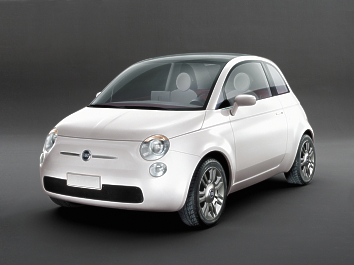
Turin - At Geneva, Fiat is introducing the 'Fiat Trepiłno', the concept car designed by the Fiat Style Centre to represent the theme of 'back to the future'. The prototype is a modern reworking of the cars that marked the first wave of mass motorisation in Italy. In fact the 'Fiat Trepiłno' prototype, immediately conveys the idea of compactness. This is due to a side section made up of several overlapping layers and a shell-shaped roof that looks much smaller than the sides when viewed from above. The car's specific proportions and certain external traits give it a fun appearance that also conveys a clear impression of solidity and sturdiness. |
|
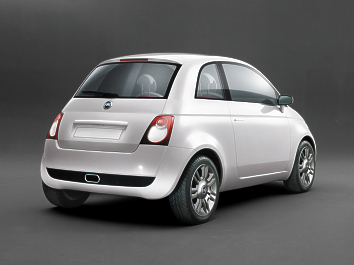
Working with a total length of just 3.3 metres, the designers lengthened the passenger compartment to obtain a pleasing shape that features a very airy side view, a very short bonnet and minimal wheel overhang. The bonnet is wrapround type and folds over the sides while the omega-shaped rib, now as then, fills the front end without adding any grilles or friezes. Due to its compact size and generous track dimensions, the 'Fiat Trepiłno' is also distinctive for its sporting, dynamic appearance.
All these retro hints share one specific characteristic: no motif has been re-used on the 'Fiat Trepiłno' before considering its usefulness on a present-day car, reviewing its functions and materials or even finding it new applications. For example, the two headlights set into the front end are accompanied by two supplementary lights that are the very essence of cutting-edge technology. The tail-lights, on the other hand, work with LCD screens that display readings in graphic mode: and so communication passes from the car's interior to its exterior. Another example of reworked style is the famous canvas hood found in some superminis of the past that has been interpreted by a Sky-dome on the 'Fiat Trepiłno'. The large window, continuous with the windscreen, stands in for the roof in linear and airy manner while emphasising the two arched pillars.
The rear end reproposes on the 'Fiat Trepiłno' a tailgate with a higher threshold that incorporates the rear window and roof spoiler. The solution adopted is very practical for loading and unloading everyday items.
Photos: Fiat
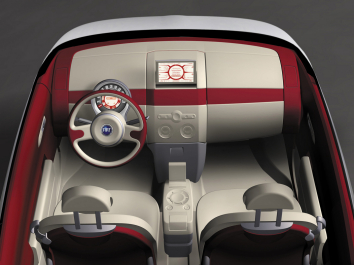
And so from the exterior to the interior. The passenger compartment is airy and spacious, a place where you can live well and be at your ease throughout the time you spend in your car. And it is also a welcoming, protective place due to the broad ring that delimits the entire interior space.
The appointments include front seats of minimum thickness that offer more comfort than seats with conventional padding. They are made out of a layer of soft polyurethane that is complemented by a more rigid polyurethane structure to create a flexible, comfortable three-layer structure able to absorb all loads and, above all, not detract from the volume and space.
All this makes it possible to reconfigure the interior to suit the car's various applications and also to accommodate tall people in the back. In a normal 3+1 configuration, the front passenger seat is moved so far forward that it is almost swallowed up by the facia. The facia can be deflated by means of a conversion process to leave room for the front passenger's legs. This makes more room available for people in the corresponding rear seat.
New material technology has made the 'Fiat Trepiłno' the first car to transcend the classic '2+2' arrangements of certain coupés or open-topped sports cars and also the configurations of many city cars that limit passenger room to just two seats in the front. The prototype has thus made it possible for the 3+1 concept to be introduced for cars with little room in the back. This has been achieved through an innovative structure, able to adapt to the most common transport needs and satisfy the greatest number of users: 2 seats, 3 seats, 3+1 emergency seat. To sum up, the Fiat prototype joins the boot compartment to the facia by means of a set of possible conversions that effectively make the interior fully reconfigurable.
Fiat Auto thanks the following for their help in the production of this concept: Bosch, Ficosa, Hitachi, I.D.E.A. Institute, IXFIN Magneti Marelli, Johnson Controls, Pirelli, Rieter and Toora.
(Feb. 17, 2004)
| .
Homepage News Companies Management Publications Events Careers Services Discussion Guestbook Search . |