2007 Salon
International de l'Auto et Accessoires, Geneva, Switzerland
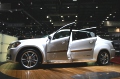
EDAG LUV Concept
Maritime Flair for the Road:
“EDAG LUV” - a modular vehicle concept
Click to enlarge
“Cast off!” The new concept car from EDAG
Engineering + Design AG will be making its first appearance on March 6,
2007, in Geneva – the “EDAG LUV”. The design concept of the “LUV” is based
on an luxury-class SUV and incorporates a maritime look from bow to stern:
oiled teakwood on the hood, as the flooring on the interior, and on the
elegant cargo area conveys a maritime flair. But the “EDAG LUV” is a real
eye-catcher in other respects as well: the cargo area, behind the two rows
of seats with plenty of room for 5 passengers, has been outfitted with
teakwood and distinctly resembles a quarterdeck – in keeping with the
maritime look of the concept car.
.
.
But the maritime design of the
“EDAG LUV” is just the covering for a modular concept which makes it
possible to turn vehicles into derivatives or niche vehicles at
reasonable expenditures of time and money. In coming up with their
shell concept, the EDAG team of engineers, headed by project
manager Andreas Funk, set themselves the goal of using the
greatest possible number of carry-over parts. The group can
certainly be proud of the results of the intelligent module concept:
90% of the parts required to perform the metamorphosis of a
luxury-class SUV into the “EDAG LUV” come off the parts shelf of the
basic vehicle.
For example, the extension of the floor pan
by 512 mm was realized using original parts. The wheelhouses were also
used without any modifications, as were the parts for the rear-end finish,
which includes integration of the standard power-lift system from the sedan.
Click to enlarge
Click to enlarge
Click to enlarge
Click to enlarge
Click to enlarge
Click to enlarge
Click to enlarge
“In addition to our efforts to use a
maximum number of identical parts, we were especially careful to keep
the existing production concept of the basic vehicle in mind during the
development of the ‘EDAG LUV’,” explains Andreas Funk. “The
self-supporting body can be completely welded using standard tongs. It
goes without saying that we used simulation models during the
development of the entire body concept to test crash behavior and
rigidity so that we could guarantee the highest level of quality and
safety.”
The advantages of the EDAG module
concept are obvious. Thanks to the use of identical parts and taking
into account the production concept, a vehicle concept which is visually
completely new can be realized under economically interesting
conditions. “More and more end customers are asking for niche vehicles,
and this type of design turns the production of such cars into a
‘business case’ for the manufacturers,” points out Johannes Barckmann,
Head of Design at EDAG, in describing the concept.
“LUV”, the name of the concept car,
is not only a term used by sailors (it is German for “luff”, the
windward side of a vessel), but also defines a new vehicle segment – the
luxury utility vehicle. “In taking the maritime world as a leitmotif for
the design of the ‘EDAG LUV’, we deliberately selected a niche theme. We
wanted to demonstrate in exemplary fashion that it is possible to create
a distinctive vehicle class and not only to give a vehicle a new look.
And to do that with as little technical effort as possible,” is how
Johannes Barckmann explains the intentions behind the design
concept.
So the cargo area of the “EDAG LUV”
is elegantly tied in with the passenger cell by the harmonious lines of
the body design. The utility vehicle character so often evident in
pick-up models is no longer discernible in the “EDAG LUV”. On the
contrary, the “EDAG LUV” radiates elegance and autonomy and cannot be
classified by any of the vehicle segments existing today. Yet the luxury
image which has been created is only one example for the idea of a
versatile vehicle concept.
Speaking of versatility: the
pick-up module can be exchanged for a convertible or coupe module simply
by releasing a catch mechanism integrated into the body of the “EDAG
LUV”. A clever move by the EDAG developers so that additional derivative
variants can be realized flexibly and at low cost.
The “EDAG LUV” has innovative solutions
on the inside as well. The EDAG development team has integrated two
UMPCs (UltraMobile PCs) into the headrests, bringing the PC world into
the vehicle. The user can use a specially developed mechanism to insert
the fully operational PCs easily into the headrests. Passengers in the
rear seat can use their Office applications such as PowerPoint, Excel,
and Word in the vehicle, plus WLAN and UMTS provide them with Internet
access, enabling them to download and answer their e-mails during the
trip.
Furthermore, integrated Webcams
even make it possible to hold Net meetings during the trip. Users can
also access their music or DVD collection from the car. The trick: The
UMPCs are connected to the vehicle’s audio system so that the MP3 files
or videos stored on the computer can also be used in the vehicle.
The integration of the computer keyboards
into the interior of the “EDAG LUV” has also been handled elegantly: modern
form-fitting foil keyboards have been embedded in the folding tables
available for use by rear-seat passengers. Background lighting makes it
possible to work even while traveling at night and is yet another futuristic
design element in the interior.
Click to enlarge
“The integration of so-called consumer
devices into the vehicle architecture is a highly interesting topic for
the manufacturers. This can result in a genuine additional value for the end
customers by making the functionality of the PC world usable in the vehicle
as well,” notes Dr. Robert Hentschel, Director of EDAG
Electrics/Electronics. “Being a full-range developer of vehicles and an
integrator in the field of electrics/electronics, we are determined to
develop solutions in this area which are stylish, geometrically and
functionally high-quality, and practical."
Click to enlarge
Click to enlarge
EDAG is currently pursuing two
solution approaches:
1. A second integration stage will tie
the UMPCs into the vehicle architecture for luxury-class vehicles.
The advantage: the driver can use operating elements – e.g., on the
steering wheel – to access directly the functions or data of the
UMPC.
2. The EDAG developers are planning
the UMPC as an after-market product for compact and midsize cars.
The aim here is to develop concepts for various models produced by
car-makers so that the devices can be integrated ergonomically and
geometrically into the interior without a jarring visual effect.
What makes this especially enticing is the possibility of utilizing
the UMPC as an on-board computer and high-quality display device by
connecting it to the vehicle architecture, providing yet another
service, as well as making the complete functionality of a PC
available in the car.
With this as a goal, EDAG is working
closely with the Intel Corporation on the development of solutions for
the electrical and electronic connection as well as on the integration of
“nomadic devices” in the vehicle interior. EDAG will rely on the latest in
Intel technology, processors, and chip sets. Especially small dimensions for
the chips and low energy consumption are only some of the criteria for their
use in cars.
The Company is planning to present the “EDAG
LUV” at the upcoming IAA in Frankfurt in the second integration
stage, i.e., with access to the UMPCs via operating elements of the car.
EDAG presented the “EDAG LUV” in Geneva
as proof of its competence, underscoring the capabilities of the world’s
largest independent development partner to develop economically sound
innovative vehicle concepts optimized for production. The project has been
realized in only three months, from definition of the concept and design
process to the development to the ready-to-roll prototypes, and is on the
verge of being realized as a Premium Edition.
BRABUS is one of the partners in this
project. The tuner from Bottrop contributed not only the 462 hp / 340 kW
high-performance BRABUS 6.1 displacement engine for the EDAG LUV that allows
this all-wheel-drive vehicle to accelerate to 100 km/h in a little more than
six seconds for a speed of 250 km/h.
BRABUS also provides the classy 10Jx22
monoblock S wheels fitted with 295/35 ZR 22 YOKOHAMA tires, the air
suspension module as well as the high-performance brake system from its
product line-up. The 12-piston aluminum fixed calipers and ventilated,
perforated 380 x 36 millimeter front brake disks and the 6-piston fixed
calipers and 355 x 28 mm rear brake disks reach a braking performance
typically achieved only by genuine sports cars.
Exclusive all-leather appointments and
attractive interior accessories are an additional BRABUS specialty. The
BRABUS saddlery combined the finest white leather with black seams and cords
for a superior interior finish of the EDAG LUV that leaves nothing to be
desired.